Solid Propellants & Rocket Motor Flooring
Conductive flooring systems engineered for solid rocket motor casting, propellant extrusion, grain trimming, and composite propellant mixing. HTPB, PBAN, nitrocellulose, and ammonium perchlorate composite chemistries — chemical-resistant systems designed for the highest-energy production in the pillar.
GET A FREE QUOTE

Flooring Built for Solid Rocket Motor Production
Solid rocket motor production is one of the highest-energy manufacturing processes in the defense and aerospace industries. HTPB-bound composite propellants, PBAN composites, nitrocellulose-based rocket propellants, and the ammonium perchlorate oxidizers that power most of them represent chemistries that would ignite under conditions a general industrial facility would never consider dangerous. The flooring under that production has to carry the heavy equipment used in casting, extrusion, and grain-trimming operations while providing a conductive path that drains static before it can accumulate.
PumaCRETE® specifies the 301 Series heavy-duty conductive urethane cement across most rocket-motor production, with 200 Series coating in lighter-duty mix rooms and inspection areas. The 1/4-inch urethane cement topping provides chemical resistance to the full propellant-ingredient chemistry universe — binders, oxidizers, cure agents, plasticizers, and the solvents used to clean them.
This page sits under Energetics & Propellants. Related: Hypergolic & Liquid Propellants, Igniters & Squibs (motor igniter production), and Large Caliber & Artillery (shares propellant-loading expertise).
Standards & Compliance Framework
Different sub-industries answer to different combinations of regulators, but the flooring requirements converge. The eight standards below cover virtually every project in this pillar.
Contractors’ Safety Manual. Primary flooring requirement for rocket-motor contractors.
Electroexplosive Subsystem Safety for Space Systems. Applied to space-launch solid motor production.
Safety Standard for Explosives, Propellants, and Pyrotechnics. Applied to NASA and space-launch rocket motor production.
American Institute of Aeronautics and Astronautics. Industry-authored standards for solid rocket motor design and safety.
Technical Requirements for Rocket-Motor Flooring
Rocket-motor production floors must handle the full chemistry universe of composite propellants plus the heavy equipment used in casting, extrusion, and grain-trimming operations.
| Property | Requirement | Reference |
|---|---|---|
| Resistance to Ground | 25,000 ohms – 1.0 × 10⁶ ohms | DoD 4145.26-M |
| Point-to-Point Resistance | < 1.0 × 10⁶ ohms | ANSI/ESD STM7.1 |
| Spark Behavior | Non-sparking; no exposed ferrous aggregates | NFPA 495, DoD 4145.26-M |
| Chemical Resistance | HTPB, PBAN, AP oxidizer, nitrocellulose, isocyanate cure agents, plasticizers, cleaning solvents | Facility-specific |
| Compressive Strength | > 10,000 psi (301 Series) | ASTM C579 |
| Impact Resistance | Mandrel handling, bulk-ingredient drum transfer, casting equipment | ASTM D2794 |
| Thermal Resistance | Hot-cure propellant operations, autoclave transfer | ASTM C884 |
| Seamless Construction | Monolithic — no joints trapping propellant fines | Facility best practice |
AP oxidizer note:
Ammonium perchlorate is a strong oxidizer that aggressively attacks many flooring systems. PumaCRETE's 301 Series urethane cement is formulated to resist AP exposure for the full service life of the facility — this is not a tolerance claim, it is a design specification.
The PumaCRETE® System Families
Three product families cover the full DoD and explosives pillar. Each sub-industry page specifies the system most often used for that application; the three families below are the common foundation.

PumaCRETE 200-PumaESD-c
THICKNESS: 13-45 mils enhanced durability for impact and frequent motorized lift traffic, or restoration of damaged concrete surfaces)
Mid-build conductive epoxy coating. Primer rooms, igniter assembly, pyrotechnic mixing, lighter-duty cartridge production.
Target Resistance
25,000 ohms – 1.0 × 10⁶ ohms
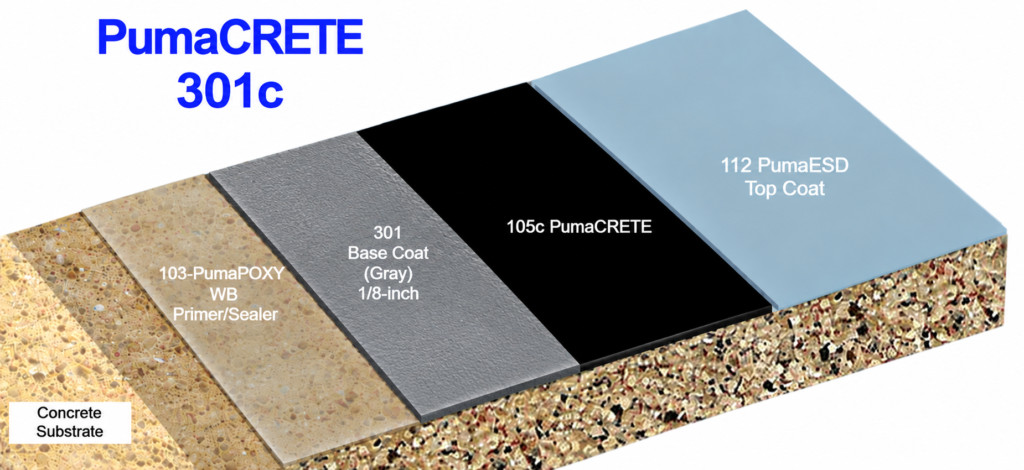
PumaCRETE 301-PumaESD-c
THICKNESS: 1/8 inch (enhance durability for impact and frequent motorized lift traffic, or restoration of damaged concrete surfaces)
Heavy-duty 1/4″ conductive urethane cement topping. Rocket motor casting, LAP lines, artillery production, DoD magazines, mine stores.
RESURFACER ADVANTAGES
Enhanced durability for impact and frequent motorized lift traffic, or restoration of damaged concrete surfaces.
Custom resistance tuning:
For Class 0 initiator work and the most sensitivity-critical operations, PumaCRETE can tune systems as low as 400,000 ohms with charge-generation under 20 volts. Contact our engineering team for a facility-specific recommendation.
Rocket-Motor Operations We Serve
PumaCRETE serves the full rocket-motor production chain, from propellant ingredient receiving through finished-motor shipping.
Propellant Mixing & Casting
Composite propellant mixing (HTPB, PBAN, AP), vacuum casting into motor cases, mandrel-based grain formation.
Propellant Extrusion
Extrusion of nitrocellulose-based propellants, double-base propellants, and specialty configurations.
Grain Trimming & Finishing
Precision machining of propellant grain geometry — the mission-critical step that defines motor burn profile.
Motor Case Preparation
Case cleaning, insulation installation, liner application, and preparation for propellant casting.
Why Rocket Motors Need Both Chemistry and Durability
Most AA&E floors face one engineering problem — either chemistry resistance or heavy traffic. Rocket-motor floors face both at once, continuously, for the full service life of the facility. The 301 Series was designed exactly for this envelope.
Chemistry
HTPB, PBAN, AP oxidizer, isocyanates, plasticizers, cleaning solvents. The full composite-propellant chemistry universe.
Traffic
Casting equipment, mandrel handlers, drum transfer, pallet jacks. Point loads in the tons.
Resistance
25,000–106 ohms held across the full facility for decades.
Installation, Grounding & Field Testing
Rocket-motor installations have two application-specific considerations beyond the standard PumaCRETE install process.
1
Chemistry Profile Review
PumaCRETE engineering reviews the facility's specific propellant chemistry profile before specifying the system. HTPB-based motors expose the floor to isocyanate cure agents and polyol binders. PBAN motors introduce different chemistries. The specification accounts for the full chemistry mix the floor will see over its service life.
2
Casting Pit and Equipment Integration
Casting bays typically have embedded casting pits, mandrel positioning equipment, and vacuum lines that must be integrated into the floor system. PumaCRETE coordinates with the facility's process engineers to maintain conductive continuity around every embedded feature.
3
Grounding Network
Standard 1,500-sq-ft grounding grid for casting and extrusion areas. Mix rooms and grain-trimming bays use a tighter 1,000-sq-ft grid to provide additional ground paths around operations handling loose propellant.
Frequently Asked Questions
Solid Rocket Motor Flooring FAQ's
Yes. The 301 Series conductive urethane cement is formulated specifically to resist AP exposure. AP is a strong oxidizer that attacks many flooring systems; the 301 Series is designed for the full service life of a composite propellant production facility.
Yes. The chemical resistance envelope of the 301 Series covers HTPB-based composite propellant chemistry — including the polyol binder, the isocyanate cure agent, and the plasticizers used in modern composite formulations.
Also covered. PBAN composite systems and nitrocellulose-based propellants (used in older large motors and some tactical rocket motors) are standard chemistries PumaCRETE has formulated the 301 Series to handle.
Yes. NASA and space-launch solid motor production is a core customer segment. The system specification aligns with NASA-STD-8719.12 and MIL-STD-1576 for electroexplosive subsystem safety in space systems.
Casting pits and embedded equipment are integrated into the floor system. PumaCRETE coordinates with facility process engineers to maintain conductive continuity around every embedded feature — pits, vacuum lines, mandrel positioners, and casting-support hardware.
Yes. The 301 Series is thermally resistant per ASTM C884 and handles hot-cure composite propellant operations without resistance drift or physical damage. Thermal shock resistance is a design feature.
Yes, sectionally. The 401-ECO fast-cure system allows installation one bay at a time with 12-hour return-to-service. Facilities phase around the active production schedule.
At least annually, and after any floor repair, chemistry change, or significant facility modification. NASA and space-launch programs often tie recertification to the facility's safety audit cycle under NASA-STD-8719.12.
EXPERIENCE AND EXPERTISE
THE PumaCRETE Difference
We have over 30 years of experience behind us. Customers can rest assure that the system we recommend shall be the most cost effective. We provide customized solutions for challenging issues.
