DoD & Explosives Conductive Flooring
PumaCRETE® conductive epoxy and urethane flooring systems built for the Department of Defense and the broader explosives industry — AA&E manufacturing, energetics, pyrotechnics, initiators, magazine storage, demilitarization, EOD, and commercial blasting. One hub, seven dedicated sub-industry trees, all engineered to DoD 4145.26-M, NFPA 495, and ATF resistance and spark-safety requirements.
GET A FREE QUOTE

The DoD & Explosives Flooring Pillar
The DoD and the broader explosives industry run on floors that most buyers never think about until something goes wrong. From the primer-filling room at a cartridge plant to the magazine floor at an Ammunition Supply Point, from the pyrotechnic mixing bay at a flare producer to the demil washout cell at a reclamation line — every work surface must drain static fast enough to prevent ignition, resist the chemistries involved, carry the traffic, and seal out dust that could accumulate in a joint.
PumaCRETE® designs and installs conductive flooring systems to serve this entire pillar. All PumaCRETE systems meet the 25,000 ohm to 1.0 × 10⁶ ohm conductive resistance range specified by DoD 4145.26-M and NFPA 495 — the range that drains charge aggressively enough to protect propellants, primers, initiators, and sensitive electro-explosive devices.
This hub organizes the pillar into seven focused sub-industry trees. Pick the one closest to your operation to see system options, applicable standards, and dedicated sub-industry pages.
Standards & Compliance Framework
Different sub-industries answer to different combinations of regulators, but the flooring requirements converge. The eight standards below cover virtually every project in this pillar.
Contractors’ Safety Manual for Ammunition and Explosives. Primary regulation for private AA&E contractors.
Ammunition and Explosives Safety Standards. Governs government-owned AA&E facilities.
Commerce in Explosives. Federal licensing framework for commercial explosives.
System Safety. Hazard analysis across weapons and munitions programs.
Technical Requirements Across the Pillar
The same core resistance and spark-safety envelope governs flooring across all seven sub-industries. Specific sub-industry pages tune the envelope for their operation.
| Property | Requirement | Reference |
|---|---|---|
| Resistance to Ground | 25,000 ohms – 1.0 × 10⁶ ohms | DoD 4145.26-M, NFPA 495 |
| Point-to-Point Resistance | < 1.0 × 10⁶ ohms | ANSI/ESD STM7.1 |
| Charge Dissipation (5,000 V → 0 V) | < 0.1 seconds | Industry best practice |
| Spark Behavior | Non-sparking surface; no exposed ferrous metal | NFPA 495, DoD 4145.26-M |
| Chemical Resistance | Propellants, oxidizers, solvents, cleaning agents | Facility-specific |
| Seamless Construction | Monolithic — no joints trapping energetic dust | Facility best practice |
| Impact Resistance | Pallet, drum, forklift, and shell-handling impacts | ASTM D2794 |
| Documentation | ANSI/ESD STM7.1 resistance map + point-to-point verification | DoD / ATF / OSHA audit-ready |
The common target:
Resistance to ground between 25,000 ohms and 1.0 × 10⁶ ohms, charge dissipation under 100 milliseconds, non-sparking surface — this envelope governs the entire pillar. Sub-industry pages explain where tighter tuning applies (Class 0 for initiators, 400,000-ohm for sensitive EEDs).
The PumaCRETE® System Families
Three product families cover the full DoD and explosives pillar. Each sub-industry page specifies the system most often used for that application; the three families below are the common foundation.

PumaCRETE 200-PumaESD-c
THICKNESS: 13-45 mils enhanced durability for impact and frequent motorized lift traffic, or restoration of damaged concrete surfaces)
Mid-build conductive epoxy coating. Primer rooms, igniter assembly, pyrotechnic mixing, lighter-duty cartridge production.
Target Resistance
25,000 ohms – 1.0 × 10⁶ ohms
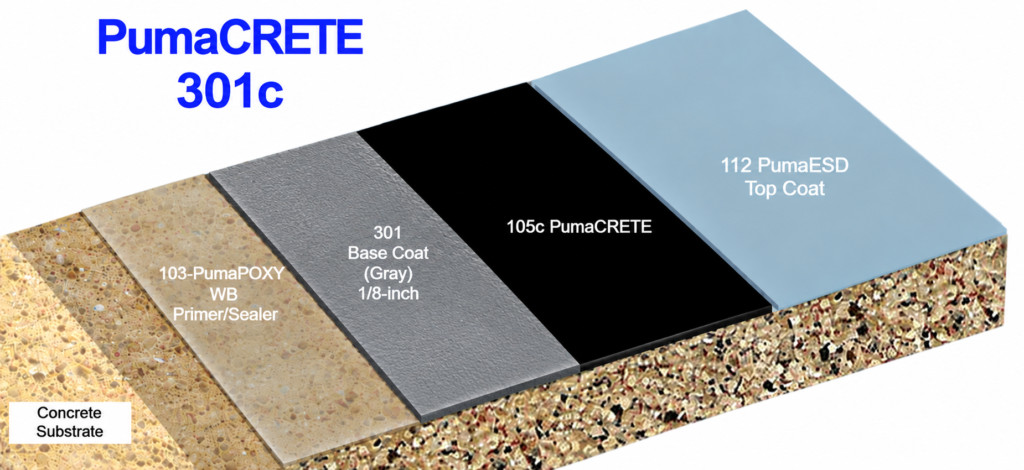
PumaCRETE 301-PumaESD-c
THICKNESS: 1/8 inch (enhance durability for impact and frequent motorized lift traffic, or restoration of damaged concrete surfaces)
Heavy-duty 1/4″ conductive urethane cement topping. Rocket motor casting, LAP lines, artillery production, DoD magazines, mine stores.
RESURFACER ADVANTAGES
Enhanced durability for impact and frequent motorized lift traffic, or restoration of damaged concrete surfaces.
Custom resistance tuning:
For Class 0 initiator work and the most sensitivity-critical operations, PumaCRETE can tune systems as low as 400,000 ohms with charge-generation under 20 volts. Contact our engineering team for a facility-specific recommendation.
The Seven DoD & Explosives Sub-Industries
Pick the sub-industry closest to your operation to see system options, applicable standards, and dedicated sub-industry pages.
Munitions & AA&E
Arms, ammunition, and explosives manufacturing. Small arms, large caliber, mortars, grenades, fuzes, and LAP operations.
Energetics & Propellants
Solid rocket motor casting, hypergolic and liquid propellants, and energetic materials R&D labs.
Pyrotechnics & Signaling
Flares, illuminants, countermeasures, decoys, and commercial pyrotechnic production.
Initiators & Detonators
Detonators, primers, igniters, squibs, electric matches, and electro-explosive devices (EEDs).
Explosives Storage & Depots
DoD magazines, ASPs, ATF-licensed facilities, and commercial explosives storage.
Demilitarization & EOD
Demil, reclamation, EOD facilities, and range clearance operations.
Commercial Blasting & Mining
Blasting agent manufacturing, bulk emulsion plants, and mine magazine flooring.
Related — Electronics ESD
Class 0 electronics manufacturing applications — shares Class 0 engineering with the Initiators branch.
Why PumaCRETE for DoD & Explosives Work
The physics of static discharge do not care whether an operator holds a DoD contract or an ATF license. A static spark that ignites a pound of propellant is the same hazard everywhere. PumaCRETE engineers the system around that reality.
Specification-Driven
Every system is engineered for the specific resistance envelope, chemistry, and traffic of the facility — not pulled off a spec sheet.
Documented Compliance
Full test reports delivered with every project, suitable for DoD, ATF, OSHA, or MSHA audit records.
Nationwide Install Network
Factory-trained crews across the U.S. — turnkey service, or materials-plus-training for your own contractor.
Operational-Facility Capable
401-ECO low-odor, fast-cure systems allow sectional retrofits inside active AA&E and energetics facilities with minimal production impact.
Installation, Grounding & Field Testing
Every DoD and explosives flooring project moves through four phases. Each phase is engineered — not improvised — because conductive floors are life-safety infrastructure, not a finish.
1
Specification & Design
PumaCRETE engineering reviews the operation, chemistry exposure, traffic class, and applicable regulations. The resistance envelope, system family, and grounding grid layout are set in writing before surface prep begins.
2
Surface Preparation
Concrete is diamond-ground or shot-blasted to CSP 3–4. Cracks and spalled joints are repaired. Moisture-vapor transmission is tested per ASTM F1869 and F2170.
3
System Install & Grounding Network
Conductive grounding strips are embedded at columns or designated ground points, typically every 1,500 square feet, and bonded to the building's earth ground. The conductive layer is installed and the topcoat cured.
4
4. Resistance Verification & Documentation
Resistance to ground is tested per ANSI/ESD STM7.1 using a 100V megohmmeter on a grid pattern. Point-to-point verification confirms continuity. A full test report is provided for the facility's safety file and DoD, ATF, or OSHA audit record.
Re-certification:
PumaCRETE recommends resistance re-verification at least annualy, and after any flooring repair or facility modification. Our testing crews can return for scheduled recertification.
Frequently Asked Questions
DoD Explosives FAQ's
A conductive floor provides a continuous, low-resistance path to ground across the entire work surface, draining static charges before they can accumulate. The DoD requires conductive floors in AA&E and energetics facilities because a single uncontrolled static discharge can ignite propellants, primers, pyrotechnics, or sensitive initiators.
DoD 4145.26-M requires flooring in ammunition and explosives work areas to provide resistance to ground between 25,000 ohms and 1.0 × 10⁶ ohms. This is the conductive range, lower than the dissipative range used for electronics manufacturing.
Yes. The Commercial Blasting & Mining branch covers blasting agent manufacturers, mining explosives storage, and other non-DoD commercial operators. Those projects answer to NFPA 495, ATF 27 CFR Part 555, and MSHA regulations.
Yes. The 401-ECO low-odor, fast-cure system is specifically engineered for sectional retrofits inside operational AA&E and energetics facilities with 12-hour return-to-service at 70°F.
Dissipative floors operate in the 106–109 ohm range and protect sensitive electronics. Conductive floors used in energetics and AA&E operate in the 25,000–106 ohm range to drain charges aggressively enough to prevent propellant ignition. Dissipative flooring is not sufficient for DoD and explosives work.
Conductive grounding strips are embedded in the floor at columns or designated ground points, typically every 1,500 square feet, and bonded to the building's earth ground. Resistance testing is performed after cure to verify continuity.
Yes. Every installation includes resistance-to-ground and point-to-point testing per ANSI/ESD STM7.1, documented in a full test report suitable for DoD, ATF, OSHA, or MSHA audit files.
At least annually, and after any flooring repair, facility modification, or significant change in operations. PumaCRETE testing crews can return for scheduled recertification.
EXPERIENCE AND EXPERTISE
THE PumaCRETE Difference
We have over 30 years of experience behind us. Customers can rest assure that the system we recommend shall be the most cost effective. We provide customized solutions for challenging issues.
