Energetics & Propellants Flooring
Conductive epoxy and urethane flooring systems engineered for solid rocket propellant manufacturing, pyrotechnic production, igniter and initiator assembly, and the handling and storage of energetic materials. Built to the resistance and spark-safety requirements of DoD 4145.26-M and NFPA 495.
GET A FREE QUOTE

Flooring Built for the World's Most Energy-Dense Materials
Energetics and propellants — solid rocket motor grain, pyrotechnic compositions, nitrocellulose-based powders, hypergolic fuels, and initiating explosives — store enormous chemical energy in very small volumes. A single uncontrolled static discharge, a dropped tool, or a wheel spark can be enough to initiate combustion or detonation.
PumaCRETE® conductive flooring provides a continuous, low-resistance path to ground across the entire work surface, draining static charges before they can accumulate on personnel, equipment, or product. Combined with non-ferrous aggregates, chemical resistance to propellant binders and oxidizers, and a seamless monolithic finish, the system is engineered specifically for the hazards of energetics production.
PumaCRETE systems are referenced throughout our broader ESD and conductive flooring line and share the proprietary conductive technology used in our conductive epoxy flooring for munitions and explosives environments.
Standards & Compliance Framework
Different sub-industries answer to different combinations of regulators, but the flooring requirements converge. The eight standards below cover virtually every project in this pillar.
Contractors’ Safety Manual for Ammunition and Explosives. Governs floors used in handling, processing, and storing military energetics. Requires continuous conductive paths and resistance to ground within a tightly bounded range.
Explosives and blasting agents regulation covering storage facilities, work areas, and separation distances. Also referenced in Bureau of Alcohol, Tobacco, Firearms and Explosives (ATF) licensed-manufacturer and licensed-dealer requirements.
Technical Requirements for Energetics Flooring
Flooring in propellant and energetics facilities must simultaneously satisfy electrical, mechanical, chemical, and safety requirements. The limits below reflect the governing standards and PumaCRETE’s own production experience.
| Property | Requirement | Reference |
|---|---|---|
| Resistance to Ground | 25,000 ohms – 1.0 × 10⁶ ohms | DoD 4145.26-M |
| Point-to-Point Resistance | < 1.0 × 10⁶ ohms | ANSI/ESD STM7.1 (conductive range) |
| Charge Dissipation (5,000 V → 0 V) | < 0.1 seconds | Industry best practice |
| Spark Behavior | Non-sparking surface; no exposed ferrous metal | NFPA 495, DoD 4145.26-M |
| Chemical Resistance | Oxidizers (AP, AN), solvents, fuels, binders | Facility-specific |
| Impact / Abrasion Resistance | Suitable for drum, pallet, and tool traffic | ASTM D4060 / D2794 |
| Seamless Construction | Monolithic — no joints to trap energetics | Facility best practice |
| Cleanability / Decontamination | Smooth, non-porous, washable | USDA / FDA finish families available |
Note on resistance ranges:
ESD dissipative floors used in electronics manufacturing operate in the 106 to 109 ohm range. Energetics and propellants require the lower conductive range (25,000 ohms to 106 ohms) because charge must be drained far more aggressively — a propellant ignition cannot be re-engineered the way a damaged chip can be.
The PumaCRETE® System Families
Three product families cover the full DoD and explosives pillar. Each sub-industry page specifies the system most often used for that application; the three families below are the common foundation.

PumaCRETE 200-PumaESD-c
THICKNESS: 13-45 mils enhanced durability for impact and frequent motorized lift traffic, or restoration of damaged concrete surfaces)
Mid-build conductive epoxy coating. Primer rooms, igniter assembly, pyrotechnic mixing, lighter-duty cartridge production.
Target Resistance
25,000 ohms – 1.0 × 10⁶ ohms
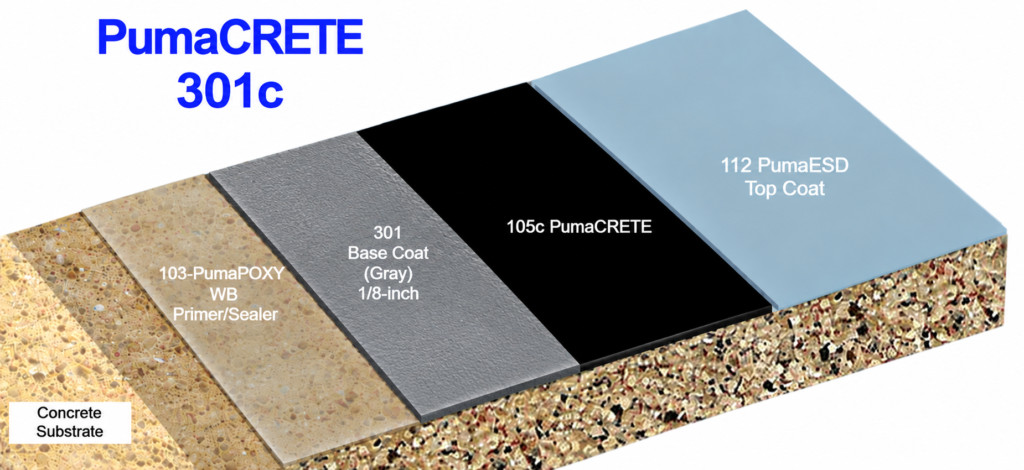
PumaCRETE 301-PumaESD-c
THICKNESS: 1/8 inch (enhance durability for impact and frequent motorized lift traffic, or restoration of damaged concrete surfaces)
Heavy-duty 1/4″ conductive urethane cement topping. Rocket motor casting, LAP lines, artillery production, DoD magazines, mine stores.
RESURFACER ADVANTAGES
Enhanced durability for impact and frequent motorized lift traffic, or restoration of damaged concrete surfaces.
Custom resistance tuning:
For Class 0 initiator work and the most sensitivity-critical operations, PumaCRETE can tune systems as low as 400,000 ohms with charge-generation under 20 volts. Contact our engineering team for a facility-specific recommendation.
Where PumaCRETE Energetics Floors Are Installed
PumaCRETE conductive systems are specified across the full energetics lifecycle, from raw material intake through end-item assembly, storage, and demilitarization.
Solid Rocket Motor Casting & Processing
Casting floors, extrusion bays, grain-trimming rooms, and X-ray inspection vaults for HTPB, PBAN, nitrocellulose, and composite propellants. Chemical resistance to isocyanates, cure agents, and plasticizers is essential.
Pyrotechnic Manufacturing
Composition mixing, pelletizing, and loading areas for flares, signaling devices, countermeasures, illuminants, and specialty effects. Non-sparking surface and tight resistance control are non-negotiable.
Igniter & Initiator Assembly
Clean, controlled-resistance work surfaces for electric match, squib, detonator, and initiator production lines. Compatible with the Class 0 charge-generation targets used for the most sensitive electro-explosive devices (EEDs).
Energetics Storage & Magazines
Magazine floors for propellant grains, bulk explosives, and finished rounds. Monolithic finish eliminates joints where fine energetic dust can accumulate and seams that are difficult to decontaminate.
Hypergolic & Liquid Propellant Handling
Transfer stations and glovebox pads for hydrazine, MMH, UDMH, nitrogen tetroxide, and other hypergolic propellants. Chemical resistance and spark safety are design-critical.
Demilitarization & Reclamation Lines
Disassembly bays, washout cells, and energetics-recovery areas where decontamination and conductivity must both be maintained for the life of the facility.
Why Conductive — Not Just Dissipative
Many facilities assume an ESD-dissipative floor is “good enough” for energetics work. It isn’t. The two systems live in different resistance universes and are engineered against different failure modes.
ESD Dissipative (Electronics)
- Resistance range: 1.0 × 10⁶ – 1.0 × 10⁹ ohms
- Protects: electronic components
- Discharge speed: controlled, moderate
- Governing standard: ANSI/E
Conductive (Energetics)
- Resistance range: 25,000 – 1.0 × 10⁶ ohms
- Protects: personnel, product, facility
- Discharge speed: aggressive, immediate
- Governing standard: DoD 41
Energetics flooring is a life-safety system, not just a quality-control measure. Using the wrong resistance range in a propellant mix room or a pyrotechnic loading cell is the difference between a floor that works and a floor that fails under the only conditions that matter.
Installation, Grounding & Field Testing
Delivering the specified resistance envelope requires a system installed and verified as a system — substrate, conductive layer, grounding network, and topcoat together. PumaCRETE installs through a nationwide network of factory-trained crews and provides on-site training for customer personnel or local contractors.
1
Surface Preparation
Concrete is diamond-ground or shot-blasted to CSP 3–4, cracks and spalled joints are repaired with epoxy paste, and moisture-vapor transmission is tested per ASTM F1869 and ASTM F2170. New concrete is allowed to cure per PumaCRETE's new-concrete requirements before coating.
2
Grounding Network
Conductive grounding strips are embedded during installation at columns or designated ground points, typically every 1,500 square feet, and bonded to the building's earth ground. For large casting bays or magazines, the ground network is laid out at design stage with the facility electrical engineer.
3
Compliance Verification
- Resistance to Ground — tested per ANSI/ESD STM7.1 using a 100 V megohmmeter on a grid pattern across the installed area.
- Point-to-Point Resistance — verified between randomly selected locations to confirm continuity.
- Documentation — a full test report is provided for the facility’s safety file and DoD or ATF audit record.
- Re-verification — PumaCRETE recommends resistance testing at least annually, and after any flooring repair.
Frequently Asked Questions
Energetics & Propellants Flooring FAQ's
ESD dissipative floors operate in the 1.0 × 10⁶ to 1.0 × 10⁹ ohm range and protect sensitive electronics. Conductive floors used for energetics and propellants operate in a much lower 25,000 ohm to 1.0 × 10⁶ ohm range to drain static charges fast enough to prevent the ignition of propellants, pyrotechnics, and explosives.
Yes. PumaCRETE conductive epoxy and urethane systems are engineered to meet the DoD Contractors' Safety Manual for Ammunition and Explosives (DoD 4145.26-M), which requires floors in energetics and explosives areas to provide a continuous path to ground with resistance between 25,000 ohms and 1.0 × 10⁶ ohms.
PumaCRETE systems are typically installed during planned downtime, but very low odor, fast-cure formulations (such as 401-ECO PumaESD‑c) are available for sensitive and operational facilities. Our team coordinates installation to minimize impact on production schedules.
Conductive flooring for propellants and pyrotechnics must provide resistance to ground between 25,000 ohms and 1.0 × 10⁶ ohms, as specified in DoD 4145.26-M and widely referenced in NFPA 495 and NFPA 400 for materials of this hazard class.
Conductive grounding tape or copper strips are embedded into the floor system during installation, typically at columns or designated ground points every 1,500 square feet, and bonded to the building's earth ground. Resistance testing is performed after cure to verify continuity.
Yes. PumaCRETE urethane cement systems are chemically resistant to a wide range of hypergolic propellants and oxidizers, including hydrazine, MMH, UDMH, and nitrogen tetroxide. We definately recommend reviewing the specific chemistry on your site so we can match the right binder family to the exposure.
In most cases, the floor is specified at the conductive end of the range because conductive flooring also satisfies the dissipative requirements used in electronics manufacturing. Where a facility handles both energetics and Class 0 electronic devices, PumaCRETE can engineer a single system that meets both targets.
EXPERIENCE AND EXPERTISE
THE PumaCRETE Difference
We have over 30 years of experience behind us. Customers can rest assure that the system we recommend shall be the most cost effective. We provide customized solutions for challenging issues.
