Pyrotechnics & Signaling Flooring
Conductive epoxy and urethane flooring systems engineered for military and commercial pyrotechnic production — flares, illuminants, countermeasures, decoys, and signaling devices. Non-sparking surfaces, tight resistance control, and chemistries matched to oxidizer-fuel compositions.
GET A FREE QUOTE

Flooring Built for Pyrotechnic Manufacturing
Pyrotechnic compositions — the oxidizer-fuel blends that drive flares, illuminants, infrared countermeasures, decoys, visible-light signaling, and commercial display effects — are among the most ignition-sensitive materials in any manufacturing environment. A single discharge from a plastic bucket, an un-grounded cart wheel, or a worker’s shoe can set a mix room on fire.
PumaCRETE® conductive flooring drains that charge before it can accumulate. Resistance to ground is held in the 25,000-ohm to 1-megohm conductive range mandated by DoD 4145.26-M and NFPA 495. Non-ferrous aggregates eliminate spark risk from dropped tools or metal objects. Seamless monolithic finishes keep pyrotechnic dust out of joints and seams.
This page is part of the PumaCRETE DoD, Explosives pillar. For related manufacturing, see our Energetics & Propellants and Initiators & Detonators pages.
Standards & Compliance Framework
Pyrotechnic manufacturers answer to DoD safety manuals, NFPA pyrotechnic-specific codes, and ATF licensing for commercial operators.
Contractors’ Safety Manual for Ammunition and Explosives. Primary regulation for military pyrotechnic contractors. Specifies conductive flooring resistance range.
Explosives and Blasting Agents. Worker-safety baseline for pyrotechnic production areas and storage magazines.
Technical Requirements for Pyrotechnic Flooring
Pyrotechnic facilities require tighter spark-safety and composition-dust control than general AA&E work. The specification envelope below reflects both the governing standards and PumaCRETE’s production experience with flare, countermeasure, and commercial pyro facilities.
| Property | Requirement | Reference |
|---|---|---|
| Resistance to Ground | 25,000 ohms – 1.0 × 10⁶ ohms | DoD 4145.26-M, NFPA 1124 |
| Point-to-Point Resistance | < 1.0 × 10⁶ ohms | ANSI/ESD STM7.1 |
| Charge Dissipation (5,000 V → 0 V) | < 0.1 seconds | Industry best practice |
| Spark Behavior | Non-sparking; no exposed ferrous aggregates | NFPA 495, DoD 4145.26-M |
| Chemical Resistance | Oxidizers (perchlorates, nitrates, chlorates), binders, solvents | Facility-specific |
| Seamless Construction | Monolithic — no joints trapping composition dust | NFPA 1124 best practice |
| Cleanability | Smooth, non-porous, washable, wet-wipe compatible | Facility SOPs |
| Abrasion Resistance | Pallet, cart, and drum traffic | ASTM D4060 |
Dust accumulation:
Pyrotechnic composition dust is both ignition-sensitive and difficult to decontaminate. PumaCRETE's seamless monolithic finish eliminates joints and seams where composition can collect — a design choice that materially reduces fire and sympathetic-detonation risk.
The PumaCRETE® System Families
Three product families cover the full DoD and explosives pillar. Each sub-industry page specifies the system most often used for that application; the three families below are the common foundation.

PumaCRETE 200-PumaESD-c
THICKNESS: 13-45 mils enhanced durability for impact and frequent motorized lift traffic, or restoration of damaged concrete surfaces)
Mid-build conductive epoxy coating. Primer rooms, igniter assembly, pyrotechnic mixing, lighter-duty cartridge production.
Target Resistance
25,000 ohms – 1.0 × 10⁶ ohms
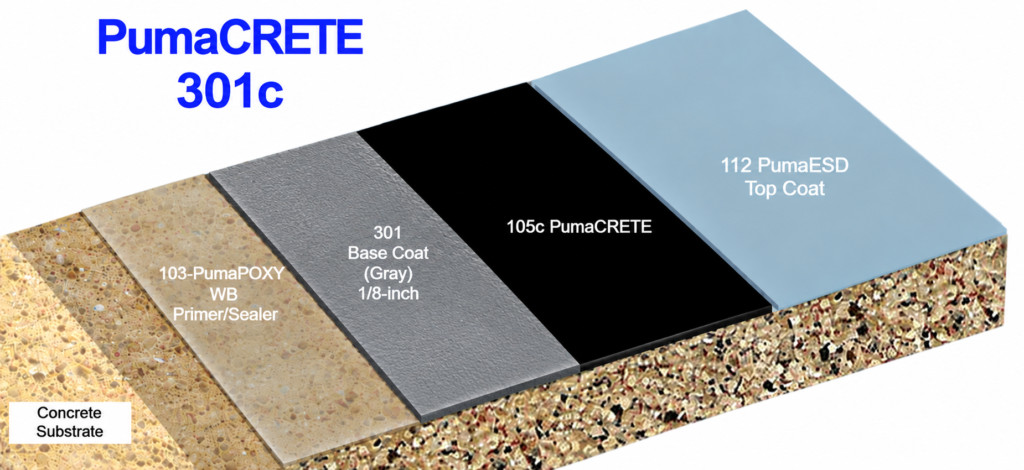
PumaCRETE 301-PumaESD-c
THICKNESS: 1/8 inch (enhance durability for impact and frequent motorized lift traffic, or restoration of damaged concrete surfaces)
Heavy-duty 1/4″ conductive urethane cement topping. Rocket motor casting, LAP lines, artillery production, DoD magazines, mine stores.
RESURFACER ADVANTAGES
Enhanced durability for impact and frequent motorized lift traffic, or restoration of damaged concrete surfaces.
Custom resistance tuning:
For Class 0 initiator work and the most sensitivity-critical operations, PumaCRETE can tune systems as low as 400,000 ohms with charge-generation under 20 volts. Contact our engineering team for a facility-specific recommendation.
Pyrotechnic Sub-Industries We Serve
PumaCRETE supports both military and commercial pyrotechnic manufacturing. Each sub-industry has its own dedicated page.
Flares & Illuminants
Military and commercial flare production — handheld signaling flares, parachute flares, trip flares, and battlefield illuminants. Conductive flooring is mission-critical throughout mixing, pelletizing, and loading.
Countermeasures & Decoys
IR countermeasures, chaff dispensers, and decoy production for aircraft and naval platforms. Tight resistance control around sensitive IR compositions.
Commercial & Entertainment Pyro
Commercial display fireworks, stage effects, and entertainment pyrotechnics. ATF-licensed manufacturers governed by NFPA 1124 and 1126.
Related — Energetic R&D Labs
Pyrotechnic composition R&D labs frequently share floor-system requirements with their production counterparts. Covered on the Energetics R&D page.
Why Pyrotechnics Need the Conductive Range
Pyrotechnic compositions do not need a spark to ignite — a static discharge of a few millijoules is sufficient to initiate many oxidizer-fuel mixes. ESD-dissipative flooring (106–109 ohms) drains charge too slowly for pyrotechnic work. The conductive range (25,000–106 ohms) drains aggressively enough to protect the composition.
Dissipative — Wrong for Pyro
106–109 ohms. Discharges a 5kV person to 0V in roughly 1 second. Too slow to prevent a static spark from igniting many pyrotechnic compositions.
Conductive — Required for Pyro
25,000–106 ohms. Discharges to 0V in under 100 milliseconds. Drains charge faster than it can accumulate to an ignition threshhold.
Installation, Grounding & Field Testing
Pyrotechnic installations follow the standard PumaCRETE four-phase approach, with two application-specific considerations.
Composition-Compatible Prep
Facilities retrofitting existing production space must completely decontaminate the substrate before coating. PumaCRETE coordinates with the facility's safety officer on decontamination protocols before surface prep begins — residual oxidizer in a crack can compromise the entire install.
Grounding Grid
Conductive grounding strips are embedded at columns or ground points typically every 1,500 square feet. For mix rooms and loading bays, we recommend a tighter 1,000-sq-ft grid.
Verification
- ▸ANSI/ESD STM7.1 testing across the entire installed area with a 100V megohmmeter.
- ▸Point-to-point verification for continuity.
- ▸Documentation suitable for DoD, ATF, and OSHA audit records.
Frequently Asked Questions
Pyrotechnics & Signaling Flooring FAQ's
Pyrotechnic compositions can be ignited by very low-energy static discharges — a few millijoules. Dissipative floors (106–109 ohms) drain charge too slowly to prevent ignition. The conductive range (25,000–106 ohms) drains aggressively enough to protect the composition.
Yes. PumaCRETE conductive systems meet both the resistance and non-sparking construction requirements referenced by NFPA 1124 for commercial fireworks manufacturing, along with the ATF-licensing requirements under 27 CFR Part 555.
Yes. The 401-ECO low-odor, fast-cure system is designed for sectional installation in operational facilities with 12-hour return-to-service at 70°F — critical for military flare contractors who cannot absorb long shutdowns.
Yes. PumaCRETE conductive urethane and epoxy systems are chemically resistant to the oxidizers typical of pyrotechnic composition — perchlorates, chlorates, nitrates, and the common binder-solvent systems used in flare and countermeasure production.
For mix rooms and loading bays, we recommend a tighter 1,000-square-foot grid of ground points rather than the standard 1,500 square feet. This provides faster discharge paths and additional redundancy around the most ignition-sensitive operations.
Countermeasure production typically specifies the lower end of the conductive range, often 400,000 ohms or below, because IR composition is extraordinarily sensitive. PumaCRETE can tune systems to that envelope — contact our engineering team for a facility-specific recommendation.
Yes. Commercial pyrotechnic operators licensed under 27 CFR Part 555 are a core customer segment. Our systems meet NFPA 1124 and ATF magazine construction requirements for commercial displays, consumer fireworks, and stage/entertainment pyrotechnics.
EXPERIENCE AND EXPERTISE
THE PumaCRETE Difference
We have over 30 years of experience behind us. Customers can rest assure that the system we recommend shall be the most cost effective. We provide customized solutions for challenging issues.
