Large Caliber & Artillery Flooring
Heavy-duty conductive urethane flooring systems engineered for artillery shell production, tank-round manufacturing, large-caliber propellant loading, and naval-gun ammunition assembly. Built for shell-handling traffic without compromising DoD 4145.26-M resistance requirements.
GET A FREE QUOTE

Flooring Built for Artillery and Tank-Round Production
Large-caliber ammunition — 105mm and 155mm artillery, 120mm tank rounds, naval 5-inch and 76mm shells — moves through production facilities on pallets, in bulk, and often with shell-handling equipment that puts loads on the floor measured in tons rather than pounds. The flooring under those operations has to carry that traffic for decades while maintaining the 25,000-ohm to 1-megohm conductive path that DoD 4145.26-M mandates for all AA&E production.
PumaCRETE® specifies the 301 Series heavy-duty conductive urethane cement as the standard for artillery and large-caliber production floors. The 1/4-inch screed-applied topping combines compressive strength over 10,000 psi with the conductive-resistance envelope required by DoD, meeting both the physical and electrical demands of large-caliber manufacturing in a single system.
This page sits under Munitions & AA&E. Related: LAP (final assembly), Solid Propellants (bulk propellant work), and Mortars & Grenades.
Standards & Compliance Framework
Large-caliber production answers to the full DoD AA&E regulatory stack plus specific military standards for artillery and tank ammunition qualification.
DoD 4145.26-M
Contractors’ Safety Manual. Primary flooring requirement for contractor artillery and large-caliber production.
DoD 6055.09-M
Ammunition and Explosives Safety Standards. Governs government-owned artillery plants and arsenals.
MIL-STD-882E
System Safety. Applied across artillery and tank-round programs for hazard analysis.
MIL-STD-1316
Fuze Design, Safety Criteria. Governs fuze design for artillery and tank rounds.
OSHA 29 CFR 1910.109
Explosives and Blasting Agents. Worker-safety baseline for large-caliber production.
Technical Requirements for Large-Caliber Flooring
Large-caliber production emphasizes heavy-duty compressive strength and impact resistance in addition to the standard DoD AA&E resistance envelope.
| Property | Requirement | Reference |
|---|---|---|
| Resistance to Ground | 25,000 ohms – 1.0 × 10⁶ ohms | DoD 4145.26-M |
| Compressive Strength | > 10,000 psi (301 Series) | ASTM C579 |
| Impact Resistance | Shell-handling impacts, dropped pallets, tool strikes | ASTM D2794 |
| Abrasion Resistance | Shell-handling equipment, pallet jacks, forklift traffic | ASTM D4060 |
| Point-to-Point Resistance | < 1.0 × 10⁶ ohms | ANSI/ESD STM7.1 |
| Spark Behavior | Non-sparking; no exposed ferrous aggregates | NFPA 495, DoD 4145.26-M |
| Chemical Resistance | Propellants, cutting oils, cleaning solvents, hydraulic fluid | Facility-specific |
| Thermal Resistance | Hot-fill propellant operations, autoclave transfer | ASTM C884 |
Why urethane cement for artillery
Thin-film epoxy coatings cannot carry the compressive and impact loads typical of artillery shell handling. The 1/4-inch 301 Series urethane cement topping combines a 10,000+ psi compressive strength with the conductive-resistance envelope — one system solves both problems.
The PumaCRETE® System Families
Three product families cover the full DoD and explosives pillar. Each sub-industry page specifies the system most often used for that application; the three families below are the common foundation.

PumaCRETE 200-PumaESD-c
THICKNESS: 13-45 mils enhanced durability for impact and frequent motorized lift traffic, or restoration of damaged concrete surfaces)
Mid-build conductive epoxy coating. Primer rooms, igniter assembly, pyrotechnic mixing, lighter-duty cartridge production.
Target Resistance
25,000 ohms – 1.0 × 10⁶ ohms
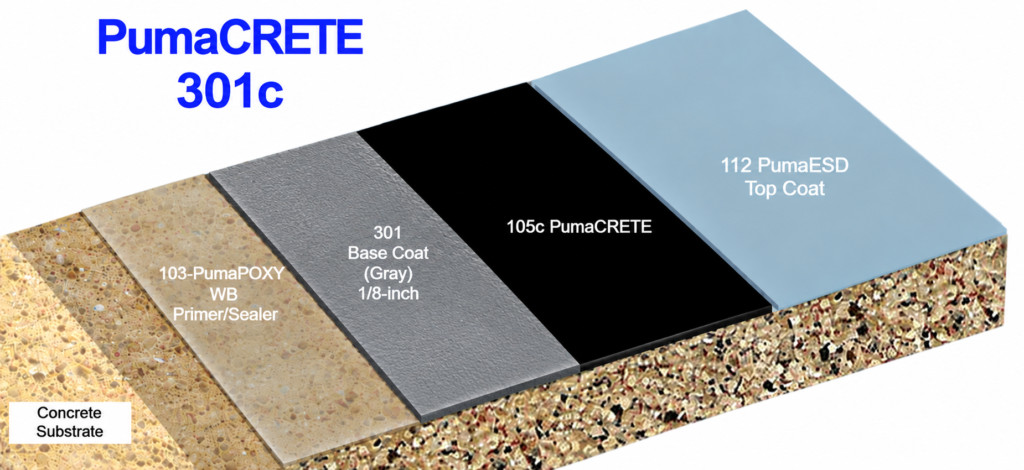
PumaCRETE 301-PumaESD-c
THICKNESS: 1/8 inch (enhance durability for impact and frequent motorized lift traffic, or restoration of damaged concrete surfaces)
Heavy-duty 1/4″ conductive urethane cement topping. Rocket motor casting, LAP lines, artillery production, DoD magazines, mine stores.
RESURFACER ADVANTAGES
Enhanced durability for impact and frequent motorized lift traffic, or restoration of damaged concrete surfaces.
Custom resistance tuning:
For Class 0 initiator work and the most sensitivity-critical operations, PumaCRETE can tune systems as low as 400,000 ohms with charge-generation under 20 volts. Contact our engineering team for a facility-specific recommendation.
Large-Caliber Operations We Serve
PumaCRETE serves the full large-caliber production chain, from shell forming through finished-round LAP.
Shell Production & Forming
Shell body manufacturing, machining, inspection, and surface preparation. Heavy pallet and shell-handling traffic throughout.
Propellant Loading
Bulk propellant filling for artillery and tank rounds, including bagged-charge operations for separately-loaded artillery.
Fuze Assembly & Insertion
Fuze assembly for artillery and tank rounds. Specific resistance considerations covered on the Mortars, Grenades & Fuzes page.
Finished-Round Staging
Finished-round storage, pallet staging, and shipping prep. Heavy forklift traffic — 301 Series territory.
Why Compressive Strength Drives the Spec
Small-arms floors can be built with 200 Series coating because the loads are light. Artillery floors cannot — the compressive and impact loads from shell handling, forklift traffic, and bulk-pallet movement require a heavier system that still meets the DoD conductive-resistance envelope.
Thin-Film Coating
Insufficient compressive strength for sustained artillery shell traffic. Delaminates and chips under load — breaks the conductive path.
301 Series Urethane Cement
10,000+ psi compressive strength. 1/4″ screed-applied topping. Holds the conductive-resistance envelope under decades of shell-handling traffic.
Installation, Grounding & Field Testing
Large-caliber installations follow the standard PumaCRETE four-phase approach, with two application-specific considerations.
Substrate Load Capacity
Large-caliber production routinely imposes point loads from shell-handling equipment that exceed what older concrete slabs were designed for. PumaCRETE engineering reviews the substrate load capacity against anticipated service loads before specifying the topping thickness and grounding grid.
Grounding Network
Standard 1,500-sq-ft grounding grid for production and LAP areas. For bagged-charge propellant loading, a tighter 1,000-sq-ft grid is specified.
Verification
Full ANSI/ESD STM7.1 testing across the installed area, with point-to-point verification for continuity. Documentation is suitable for DoD, ATF, and OSHA audit records.
Frequently Asked Questions
Large Caliber & Artillery FAQ's
The resistance envelope is the same — 25,000 ohms to 106 ohms per DoD 4145.26-M — but the physical load class is dramatically higher. Large-caliber production routinely imposes point loads from shell-handling equipment that would damage a thin-film coating. The 301 Series urethane cement topping is specified to combine the conductive requirement with the compressive strength needed for sustained artillery and tank-round traffic.
Yes. Both are core PumaCRETE customer segments. Lake City, Scranton Army Ammunition Plant-type operations and commercial defense-industry manufacturers specify the same 301 Series system family across production, LAP, and finished-round areas.
Bagged-charge operations for separately-loaded artillery (155mm, 8-inch, naval 5-inch) specify the 301 Series conductive urethane cement with a tighter 1,000-square-foot grounding grid. The additional ground points provide shorter discharge paths for operations handling loose propellant.
Yes. Naval 5-inch, 76mm, and larger shell production is a core PumaCRETE customer segment. The system specification follows the same 301 Series pattern used for Army artillery production.
Fuze assembly is covered on the Mortars, Grenades & Fuzes page — it is a sensitivity-driven specification regardless of the parent round caliber. Fuze bays typically specify the 200 Series tuned to the lower end of the conductive range, similar to primer rooms in small-arms plants.
The 301 Series conductive urethane cement is thermally resistant per ASTM C884 and handles hot-fill propellant operations without resistance drift or physical damage. Thermal shock resistance is a design feature of the system.
Yes, sectionally. The 401-ECO low-odor, fast-cure system allows one bay at a time with 12-hour return-to-service. Facilities typically phase the retrofit around the active production schedule.
At least annually, and after any floor repair, line reconfiguration, or significant change in operations. PumaCRETE testing crews can return for scheduled recertification tied to the facility's safety inspection cycle.
EXPERIENCE AND EXPERTISE
Specify PumaCRETE for Your Small-Arms Facility
Primer room, cartridge loading line, powder-charging bay, or an operational-plant retrofit — PumaCRETE engineers the floor to the primer-sensitivity, traffic, and SAAMI or DoD requirements your production actually demands.
