
Load, Assemble & Pack (LAP) Flooring
Heavy-duty conductive urethane flooring for Load, Assemble, and Pack (LAP) facilities — the final-assembly, loading, and packaging operations where propellant, warhead, fuze, and casing come together into finished rounds. Built to carry sustained forklift and pallet traffic without compromising DoD 4145.26-M.
GET A FREE QUOTE

Flooring Built for the Final-Assembly End of AA&E
LAP — Load, Assemble, and Pack — is where everything else in the AA&E supply chain comes together. Propellant arrives from one supplier, warheads from another, fuzes from a third, and the LAP facility combines them into the finished round that ships to the end user. LAP operations are high-volume, high-traffic, and high-consequence — a floor failure in a LAP line can shut down an entire ammunition supply chain.
PumaCRETE® specifies the 301 Series heavy-duty conductive urethane cement as the standard LAP floor system. The 1/4-inch screed-applied topping carries sustained forklift, pallet-jack, and drum-handling traffic for decades while maintaining the 25,000-ohm to 1-megohm conductive-resistance envelope required by DoD 4145.26-M across all LAP operations.
This page sits under Munitions & AA&E. Related: Large Caliber & Artillery, Mortars, Grenades & Fuzes, and Explosives Storage & Depots (where finished rounds go after LAP).
Standards & Compliance Framework
LAP operations answer to the full DoD AA&E regulatory stack. Government-operated LAP facilities (Army Ammunition Plants) are governed by DoD 6055.09-M; contractor-operated LAP lines by DoD 4145.26-M.
DoD 4145.26-M
Contractors’ Safety Manual. Primary regulation for contractor LAP operations.
DoD 6055.09-M
DoD Ammunition and Explosives Safety Standards. Governs government-owned Army Ammunition Plants and LAP facilities.
DoDI 5160.68
Single Manager for Conventional Ammunition. DoD’s LAP program management framework.
MIL-STD-882E
System Safety. Hazard analysis applied across LAP operations.
OSHA 29 CFR 1910.109
Explosives and Blasting Agents. Worker-safety baseline for LAP operations.
Technical Requirements LAP Flooring
LAP floors face the heaviest sustained traffic in the AA&E universe. The specification envelope emphasizes compressive strength and abrasion resistance in addition to the DoD conductive-resistance requirement.
| Property | Requirement | Reference |
|---|---|---|
| Resistance to Ground | 25,000 ohms – 1.0 × 10⁶ ohms | DoD 4145.26-M, 6055.09-M |
| Compressive Strength | > 10,000 psi (301 Series) | ASTM C579 |
| Impact Resistance | Pallet drops, drum handling, dropped tools | ASTM D2794 |
| Abrasion Resistance | Sustained forklift and pallet-jack traffic | ASTM D4060 |
| Point-to-Point Resistance | < 1.0 × 10⁶ ohms | ANSI/ESD STM7.1 |
| Spark Behavior | Non-sparking; no exposed ferrous aggregates | NFPA 495, DoD 4145.26-M |
| Chemical Resistance | Propellants, lubricants, cleaning agents, hydraulic fluid | Facility-specific |
| Seamless Construction | Monolithic — no joints trapping propellant or explosive dust | Facility best practice |
Why LAP is urethane cement territory
LAP lines run 10-hour shifts year-round with continuous forklift and pallet-jack traffic. A thin-film coating cannot sustain that duty cycle. The 301 Series urethane cement is the only PumaCRETE system specified for LAP work — the 200 Series is used only in inspection and staging areas with lighter traffic.
PumaCRETE® Systems for LAP Facilities
Fuze bays specify the 200 Series tuned low. Mortar and grenade body production uses 200 or 301 depending on traffic. 401-ECO handles retrofits.

PumaCRETE 200-PumaESD-c
Mid-build conductive epoxy coating. Used in LAP inspection bays, sub-assembly areas, and lighter-duty staging.
Target Resistance
25,000 ohms – 1.0 × 10⁶ ohms
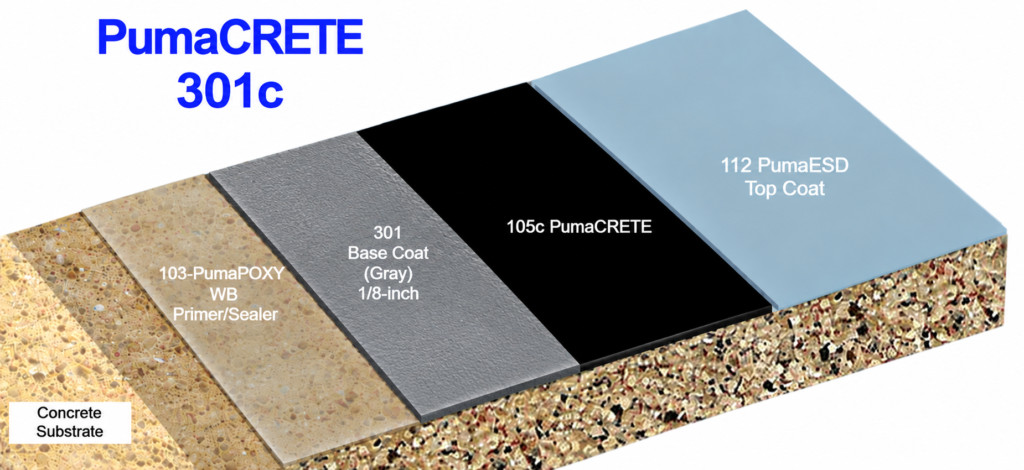
PumaCRETE 301-PumaESD-c
Heavy-duty 1/4″ conductive urethane cement topping. The LAP standard — carries sustained forklift, pallet-jack, and drum traffic.
Thickness
1/4″ screed-applied composite
LAP spec pattern:
A typical LAP facility specifies the 301 Series across production, loading, assembly, packaging, and staging — essentially the entire operational footprint — with 200 Series only in inspection labs and small sub-assembly rooms.
LAP Operations We Serve
LAP covers the full set of final-assembly operations for every round class in the AA&E inventory.
Small-Arms LAP
Cartridge loading, bullet seating, crimping, and finished-round packaging for small-arms ammunition production.
Medium & Large-Caliber LAP
Mortar, artillery, tank-round, and naval-gun final assembly, propellant loading, and shipping prep.
Grenade & Pyrotechnic LAP
Hand grenade, 40mm grenade, flare, and signaling-device final assembly and packaging.
Rocket & Missile LAP
Final assembly of rocket motors, warheads, and guidance sections for tactical and strategic missile systems.
Why LAP Floors Are the Hardest-Working in AA&E
Primer rooms are the most sensitive. Fuze bays are the most sensitivity-critical. But LAP floors face the hardest combined duty cycle in the entire pillar — sustained heavy traffic, chemical exposure, and strict conductive-resistance requirements, all at once, every day, for decades.
Traffic Load
Continuous forklift, pallet-jack, and drum traffic. Point loads from loaded shell pallets.
Chemical Load
Propellant exposure, cleaning agents, hydraulic fluid, cutting oils, lubricants.
Electrical Load
Conductive-resistance envelope held across the full LAP footprint. 301 Series urethane cement handles all three.
Installation, Grounding & Field Testing
LAP installations are planned around active production schedules. Full shutdowns of a LAP line are rare and expensive.
Sectional Installation
Most LAP retrofits are phased — one bay or production zone at a time — using the 401-ECO fast-cure system for return-to-service inside 12 hours. Production continues in adjacent zones while the retrofit crew works behind barriers.
Substrate Preparation
LAP floors routinely sit on substrate that has carried heavy traffic for decades. Diamond grinding or shot-blasting to CSP 3–4 is standard, with crack and spall repair before the topping goes down. Moisture-vapor transmission is tested per ASTM F1869 and F2170.
Grounding Network
Standard 1,500-sq-ft grounding grid for LAP production zones. For bulk-propellant loading sections, we specify a tighter 1,000-sq-ft grid.
Verification & Documentation
Full ANSI/ESD STM7.1 resistance mapping across the installed area. Documentation is suitable for DoD, OSHA, and DoDI 5160.68 program-management audit records.
Frequently Asked Questions
Load, Assemble & Pack (LAP) Flooring FAQ's
LAP stands for Load, Assemble, and Pack — the final-assembly end of ammunition production, where propellant, warhead, fuze, and casing come together into finished rounds that ship to the end user. LAP covers everything from small-arms cartridge loading to artillery shell final assembly to rocket-motor-and-warhead integration.
LAP lines run sustained forklift, pallet-jack, and drum traffic for the full life of the facility. Only the 301 Series conductive urethane cement topping has the 10,000+ psi compressive strength and abrasion resistance to carry that duty cycle while maintaining the DoD 4145.26-M conductive-resistance envelope. Thin-film coatings cannot sustain LAP service.
Yes. Government-owned AAPs — Lake City, Scranton, Radford, Iowa, Milan, and others — are core customer segments. The system specification follows DoD 6055.09-M requirements and ties into the DoDI 5160.68 program-management framework for the Single Manager for Conventional Ammunition.
Yes. The 401-ECO low-odor, fast-cure system enables sectional installation one bay at a time. LAP retrofits are typically phased around the active production schedule, with 12-hour return-to-service after each section.
Bulk-propellant loading sections — bagged-charge artillery, large-caliber separate-loading operations — specify the 301 Series with a tighter 1,000-sq-ft grounding grid. The additional ground points provide shorter discharge paths around operations with loose propellant.
Yes. The 301 Series is thermally resistant per ASTM C884 and handles hot-fill propellant operations without resistance drift or physical damage. Thermal shock resistance is a design feature of the system.
LAP output flows directly into magazines, ASPs, and depot storage, all of which specify the same 301 Series conductive urethane cement system. The grounding networks are coordinated across the LAP facility and adjacent storage so the two systems share a common earth-ground reference.
At least annually, and after any floor repair, line reconfiguration, or significant change in operations. Many facilities tie recertification to the DoDI 5160.68 program audit cycle.
EXPERIENCE AND EXPERTISE
Specify PumaCRETE for Your Load, Assemble & Pack (LAP) Flooring
60mm mortar line, 40mm grenade assembly, hand-grenade production, or a sensitivity-tuned fuze bay — PumaCRETE engineers the floor as a zoned system that matches the sensitivity envelope your operation actually needs.
