
Mortars, Grenades & Fuzes Flooring
Conductive flooring systems engineered for 60mm, 81mm, and 120mm mortar production, hand-grenade and 40mm grenade assembly, and fuze manufacturing lines. Fuze-sensitivity-tuned systems combined with the heavy-duty durability needed for finished-round handling.
GET A FREE QUOTE

Flooring Built for Mortar, Grenade, and Fuze Operations
Mortars, grenades, and fuzes sit at the intersection of two sensitivity classes in the AA&E universe. The mortar bodies and grenade bodies themselves — like other finished rounds — require the standard DoD 4145.26-M conductive-flooring envelope. The fuzes that go into them — M734, M783, M567, and the full MIL-STD-1316 family — are sensitivity-tuned devices that call for tighter resistance control, closer to the Class 0 end of the spectrum.
PumaCRETE® handles both environments. Fuze assembly bays specify the 200 Series conductive epoxy tuned to the lower end of the conductive range. Mortar and grenade production lines use the 200 or 301 Series depending on traffic class. The grounding grid is designed around the sensitivity of the fuze work, not the parent-round class.
This page sits under Munitions & AA&E. Related: Initiators & Detonators (adjacent sensitivity class), Large Caliber & Artillery (shares fuze requirements), and LAP (final assembly).
Standards & Compliance Framework
Mortar, grenade, and fuze production answers to the DoD AA&E regulatory stack plus the dedicated MIL-STD-1316 fuze design and qualification standard.
DoD 4145.26-M
Contractors’ Safety Manual. Primary flooring requirement for military mortar, grenade, and fuze contractors.
MIL-STD-1316
Fuze Design, Safety Criteria. Core fuze design and qualification standard governing resistance control around fuze production.
MIL-STD-331
Fuze and Fuze Components, Environmental and Performance Tests. Qualification test requirements for military fuzes.
ANSI/ESD STM97.2
Floor Materials and Footwear Body Voltage Generation. Applied for fuze-sensitivity verification.
OSHA 29 CFR 1910.109
Explosives and Blasting Agents. Worker-safety baseline.
Technical Requirements Fuze Bays vs Production Lines
Fuze bays require tighter resistance control than mortar or grenade production. The envelope below spans both areas, with fuze-specific adjustments noted.
| Property | Requirement | Reference |
|---|---|---|
| Resistance to Ground (production) | 25,000 ohms – 1.0 × 10⁶ ohms | DoD 4145.26-M |
| Resistance to Ground (fuze bays) | 25,000 ohms – 400,000 ohms (tuned) | MIL-STD-1316 + Class 0 practice |
| Body Voltage Generation (fuze bays) | < 100 V standard; < 20 V for Class 0 fuzes | ANSI/ESD STM97.2 |
| Point-to-Point Resistance | < 1.0 × 10⁶ ohms | ANSI/ESD STM7.1 |
| Spark Behavior | Non-sparking; no exposed ferrous aggregates | NFPA 495, DoD 4145.26-M |
| Impact Resistance | Mortar body handling, grenade pallet drops | ASTM D2794 |
| Abrasion Resistance | Pallet jack, cart, and finished-round traffic | ASTM D4060 |
| Seamless Construction | Monolithic — no joints trapping energetic dust | Facility best practice |
Fuze-sensitivity note
Modern fuzes include electronic initiation chains, piezoelectric elements, and electro-explosive sub-assemblies that respond to static discharges in the sub-250V range. Fuze-bay flooring is a Class 0 or near-Class 0 specification regardless of the parent-round caliber.
The PumaCRETE® System Families
Three product families cover the full DoD and explosives pillar. Each sub-industry page specifies the system most often used for that application; the three families below are the common foundation.

PumaCRETE 200-PumaESD-c
THICKNESS: 13-45 mils enhanced durability for impact and frequent motorized lift traffic, or restoration of damaged concrete surfaces)
Mid-build conductive epoxy coating. Primer rooms, igniter assembly, pyrotechnic mixing, lighter-duty cartridge production.
Target Resistance
25,000 ohms – 1.0 × 10⁶ ohms
PumaCRETE 301-PumaESD-c
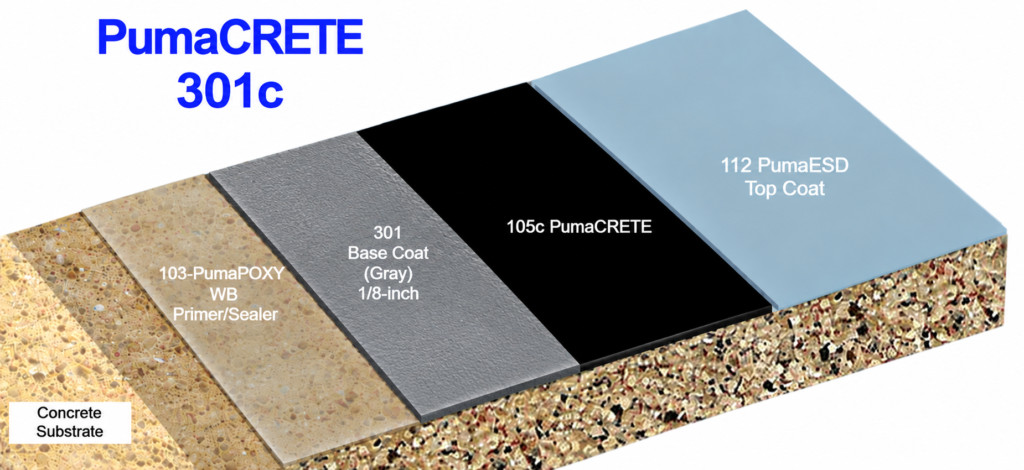
THICKNESS: 1/8 inch (enhance durability for impact and frequent motorized lift traffic, or restoration of damaged concrete surfaces)
Heavy-duty 1/4″ conductive urethane cement topping. Rocket motor casting, LAP lines, artillery production, DoD magazines, mine stores.
RESURFACER ADVANTAGES
Enhanced durability for impact and frequent motorized lift traffic, or restoration of damaged concrete surfaces.
Custom resistance tuning:
For Class 0 initiator work and the most sensitivity-critical operations, PumaCRETE can tune systems as low as 400,000 ohms with charge-generation under 20 volts. Contact our engineering team for a facility-specific recommendation.
Mortar, Grenade & Fuze Operations We Serve
PumaCRETE serves the full production chain for mortars, grenades, and the fuzes that make them work.
Mortar Body Production
60mm, 81mm, and 120mm mortar body manufacturing, propellant loading, and assembly. Heavy-pallet traffic in bulk-production areas.
Grenade Assembly
Hand grenade (M67), 40mm grenade (M203/M320), and specialty grenade production. Combination of body-handling and sensitivity-tuned sub-assembly.
Fuze Manufacturing
Fuze assembly for mortars, grenades, artillery, and tank rounds. Sensitivity-tuned conductive flooring with Class 0 charge-generation targets.
LAP (Final Assembly)
Final loading, assembly, and packaging — covered on the LAP page under Munitions & AA&E
Why Fuzes Drive the Floor Spec
A mortar body is a chunk of metal. A fuze is an electronic initiator with piezoelectric or electro-explosive elements. The floor under fuze production has to protect the fuze — and the fuze is dramatically more sensitive than the round it goes into.
Round Production
Standard DoD 4145.26-M conductive envelope. 200 or 301 Series. 1,500-sq-ft grounding grid.
Fuze Assembly
Class 0 or near-Class 0 envelope. 200 Series tuned to 400,000 ohms. BVG below 20V. 1,000-sq-ft grounding grid.
Installation, Grounding & Field Testing
Mortar, grenade, and fuze installations are built around the sensitivity gradient across the plant.
Zone-Based Specification
PumaCRETE engineers typically specify a two-zone floor system: 301 Series across body production and bulk operations, 200 Series tuned to the lower end of the conductive range across fuze bays. The grounding grid density changes between zones — 1,500 sq ft in production, 1,000 sq ft in fuze bays.
Fuze-Bay Verification
Fuze bays receive ANSI/ESD STM97.2 body voltage generation testing in addition to the standard STM7.1 resistance mapping. BVG is tested with the facility's own footwear to confirm the full system meets the Class 0 target.
Operational Retrofits
The 401-ECO fast-cure system enables sectional installation in operational mortar and grenade plants. Standard sequence: fuze bays first (during planned safety outages), then production lines (sectionally), then LAP and staging.
Frequently Asked Questions
Mortars & Grenades FAQ's
Fuzes contain electro-explosive sub-assemblies and sensitivity-tuned initiation chains that respond to static discharges below 250 volts. The floor under fuze production has to be tuned closer to the Class 0 end of the conductive range — around 400,000 ohms resistance with body-voltage generation under 20 volts — rather than the standard DoD 4145.26-M envelope used in body production.
Yes. The 200 Series conductive epoxy, tuned to the Class 0 envelope and verified by ANSI/ESD STM7.1 resistance mapping and STM97.2 body-voltage generation testing, meets the resistance-control requirements referenced in MIL-STD-1316 for fuze design and qualification environments.
Not optimally. We recommend a zone-based specification: 301 Series for body production and bulk operations, 200 Series tuned to the Class 0 range for fuze bays. The grounding grid density also changes between zones. The two systems meet at a transition line engineered to preserve electrical continuity.
40mm grenades (M203/M320 ammunition) combine a propellant cartridge with a fuzed warhead. The production floor runs the same two-zone pattern: 301 Series in body manufacturing and LAP, 200 Series tuned for fuze assembly.
Yes. M67 fragmentation grenades, specialty grenades, and training-round production are core customer segments. The system specification follows the same two-zone pattern.
Tighter than production. Fuze bays specify ground points every 1,000 square feet instead of the standard 1,500 used in production and bulk-handling areas. The additional ground points provide shorter discharge paths for the sensitivity-critical operations.
Yes. The 401-ECO fast-cure system enables sectional installation one bay at a time. Standard sequence is fuze bays first (during planned safety outages), then production lines, then LAP and staging areas.
Resistance at least annually per ANSI/ESD STM7.1. Body voltage generation at least annually with the facility's current footwear per STM97.2. Both tests should be repeated after any floor repair, footwear program change, or facility modification.
EXPERIENCE AND EXPERTISE
Specify PumaCRETE for Your Mortar, Grenade, or Fuze Facility
60mm mortar line, 40mm grenade assembly, hand-grenade production, or a sensitivity-tuned fuze bay — PumaCRETE engineers the floor as a zoned system that matches the sensitivity envelope your operation actually needs.
