Initiators & Detonators Flooring
Conductive epoxy and urethane flooring systems engineered for detonator, primer, igniter, squib, electric match, and electro-explosive device (EED) production. Resistance tunable to Class 0 charge-generation targets for the most sensitive devices in the explosives industry.
GET A FREE QUOTE

Flooring Built for the Most Sensitive Explosive Devices
Initiators and detonators are the smallest-energy, highest-sensitivity components in any explosive train. A detonator cap, a cartridge primer, an electric match, or an electro-explosive device (EED) can be initiated by levels of static that would never trouble a propellant or a bulk explosive. The flooring in a facility that produces these devices has to drain charge faster, and more completely, than almost any other industrial surface.
PumaCRETE® conductive flooring is engineered for exactly this. Resistance to ground is held in the lower end of the DoD 4145.26-M conductive range, with systems tunable as low as 400,000 ohms for Class 0 handling. Non-ferrous aggregates prevent spark initiation from dropped tools or metal objects. Charge-generation targets of under 20 volts are achievable with the right footwear program.
This page sits in the PumaCRETE DoD, Explosives pillar. Also see Munitions & AA&E (where primers are used), Pyrotechnics & Signaling, and Electronics Manufacturing for the related Class 0 electronics applications.
Standards & Compliance Framework
Initiator production answers to DoD safety manuals, dedicated EED military standards, and the broader ANSI/ESD framework that governs sensitive-device handling.
DoD 4145.26-M
Contractors’ Safety Manual for Ammunition and Explosives. Primary flooring resistance requirement for initiator contractors.
MIL-STD-1512
Electroexplosive Subsystems, Electrically Initiated, Design Requirements and Test Methods. Core EED design and handling standard.
MIL-STD-1576
Electroexplosive Subsystem Safety Requirements and Test Methods for Space Systems. Applied to space-launch EED and initiator production.
ANSI/ESD S20.20
ESD Control Program. Baseline for Class 0 device handling — body-voltage generation under 100V, resistance under 109 ohms.
ANSI/ESD STM7.1
Floor Materials — Resistive Characterization. The verification test method used for both conductive and dissipative flooring.
Technical Requirements Initiator Flooring
Initiator work demands tighter resistance control and lower charge generation than general AA&E or energetics manufacturing. The envelope below reflects both DoD requirements and the ANSI/ESD framework used for Class 0 sensitive devices.
| Property | Requirement | Reference |
|---|---|---|
| Resistance to Ground | 25,000 ohms – 1.0 × 10⁶ ohms (standard); tunable to 400,000 ohms for Class 0 | DoD 4145.26-M + Class 0 best practice |
| Point-to-Point Resistance | < 1.0 × 10⁶ ohms | ANSI/ESD STM7.1 |
| Body Voltage Generation | < 100 V (with footwear program); < 20 V for Class 0 | ANSI/ESD STM97.2, Class 0 practice |
| Charge Dissipation (5,000 V → 0 V) | < 0.1 seconds (standard); < 50 ms for Class 0 | Industry best practice |
| Spark Behavior | Non-sparking; no exposed ferrous aggregates | NFPA 495, DoD 4145.26-M |
| Chemical Resistance | Primary explosives (lead azide, lead styphnate), solvents, cleaning agents | Facility-specific |
| Seamless Construction | Monolithic — no joints trapping initiator fines | Facility best practice |
| Cleanability | Smooth, non-porous, decontaminable | Facility SOPs |
Class 0 note
Class 0 is the ANSI/ESD designation for devices susceptible to damage from static discharges of less than 250 volts. Most EEDs, electric matches, and sensitive detonators fall into this class. The lower-than-standard resistance envelope PumaCRETE can achieve is specifically for these devices.
The PumaCRETE® System Families
Two product families cover the full DoD and explosives pillar. Each sub-industry page specifies the system most often used for that application; the three families below are the common foundation.

PumaCRETE 200-PumaESD-c
THICKNESS: 13-45 mils enhanced durability for impact and frequent motorized lift traffic, or restoration of damaged concrete surfaces)
Mid-build conductive epoxy coating. Primer rooms, igniter assembly, pyrotechnic mixing, lighter-duty cartridge production.
Target Resistance
25,000 ohms – 1.0 × 10⁶ ohms
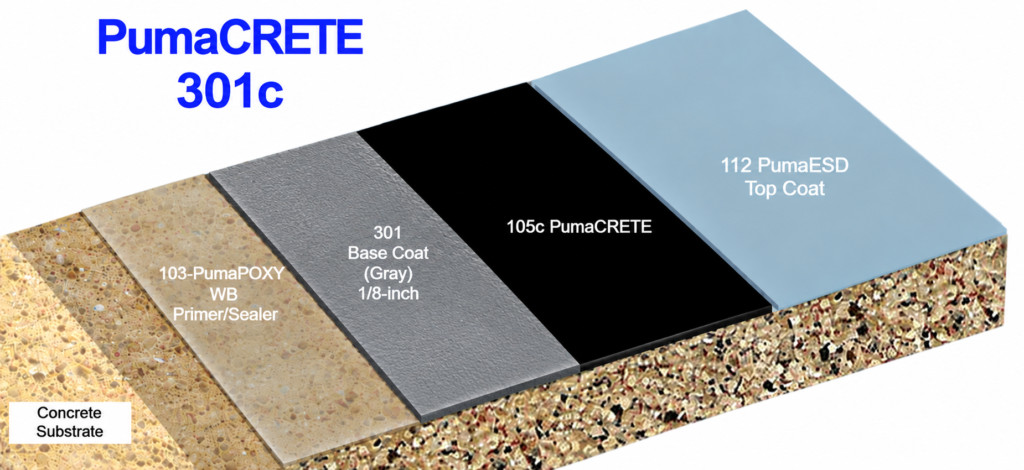
PumaCRETE 301-PumaESD-c
THICKNESS: 1/8 inch (enhance durability for impact and frequent motorized lift traffic, or restoration of damaged concrete surfaces)
Heavy-duty 1/4″ conductive urethane cement topping. Rocket motor casting, LAP lines, artillery production, DoD magazines, mine stores.
RESURFACER ADVANTAGES
Enhanced durability for impact and frequent motorized lift traffic, or restoration of damaged concrete surfaces.
Custom resistance tuning:
For Class 0 initiator work and the most sensitivity-critical operations, PumaCRETE can tune systems as low as 400,000 ohms with charge-generation under 20 volts. Contact our engineering team for a facility-specific recommendation.
Initiator Sub-Industries We Serve
The initiator category covers a wide range of sensitive-device manufacturing. Each sub-industry has its own dedicated page.
Detonators & Primers
Detonator caps, blasting caps, cartridge primers, percussion primers, and shock-tube detonators. The high-volume core of initiator manufacturing.
Igniters, Squibs & Electric Matches
Pyrotechnic and rocket-motor igniters, aerospace squibs, electric matches for commercial pyro, and ignition devices for airbag/safety systems.
Electro-Explosive Devices (EEDs)
Military and aerospace EEDs — exploding bridgewire detonators, slapper detonators, exploding foil initiators, and other precision electro-explosive subsystems.
Related — Class 0 in Electronics
Class 0 electronic devices (semiconductors in microelectronics manufacturing) share the sub-20V charge generation target. Covered under Electronics Manufacturing.
Why Initiator Facilities Need the Tightest Flooring Specs
An initiator is engineered to be sensitive — that’s its job. The flooring protecting it has to be engineered for the same end of the sensitivity curve. ESD-dissipative flooring is inadequate for Class 0 devices; general-conductive flooring is a starting point.
Dissipative
106–109 ohms. For electronics ESD control. Inadequate for Class 0 initiators.
Standard Conductive
25,000–106 ohms. Baseline DoD 4145.26-M requirement. Acceptable for most primer and detonator work.
Class 0 Tuned
400,000 ohms or lower, <20V BVG. Required for EEDs, electric matches, exploding bridgewire detonators.
Installation, Grounding & Field Testing
Initiator floors are installed with extra attention to grounding grid density, charge-generation validation, and footwear-program coordination.
1
Grounding Grid
For Class 0 and EED facilities, we specify a tighter 1,000-sq-ft grid of ground points instead of the standard 1,500 square feet. The denser grid provides shorter discharge paths and better redundancy.
2
Charge Generation Testing
For Class 0 projects, we add ANSI/ESD STM97.2 body-voltage generation testing to the standard STM7.1 resistance verification. BVG is tested with the facility's own footwear to confirm the full system — floor plus personnel grounding — meets the 20-volt Class 0 target.
3
Footwear Coordination
Floor resistance and footwear resistance are a system — one does not work without the other. PumaCRETE coordinates with the facility's safety officer on footwear specification before the floor is installed, so the final BVG numbers meet the Class 0 target the first time.
4
Documentation
Full test reports include STM7.1 resistance maps, STM97.2 BVG data (where applicable), and point-to-point verification — suitable for DoD, ATF, OSHA, and FAA audit records.
Frequently Asked Questions
Initiators & EEDs FAQ's
Class 0 is the ANSI/ESD sensitivity designation for devices susceptible to damage or initiation from static discharges below 250 volts. EEDs, electric matches, exploding bridgewire detonators, and some semiconductors fall into this class. Class 0 handling requires tighter resistance control (toward 400,000 ohms) and body-voltage generation under 20 volts.
Yes. With a tuned 200 Series or 301 Series system plus a coordinated footwear program, PumaCRETE regularly achieves body-voltage generation under 20 volts, verified per ANSI/ESD STM97.2.
Yes. Detonators and primers are a core PumaCRETE customer segment. We serve both military contractors (governed by DoD 4145.26-M) and commercial detonator manufacturers (governed by NFPA 495 and ATF 27 CFR Part 555).
All three are electrically-fired initiators, but their applications differ. Igniters start propellant combustion in rocket motors and solid-fuel systems. Squibs are small pyrotechnic devices used in aerospace and automotive safety systems (airbags, seat-belt pretensioners). Electric matches are low-cost commercial igniters used in display pyrotechnics. All three require conductive flooring, with electric matches and precision squibs often requiring Class 0 handling.
EED stands for Electro-Explosive Device — any explosive component initiated by electrical signal. Exploding bridgewire detonators, slapper detonators, and exploding foil initiators are all EEDs. They are among the most electrostatically sensitive devices in the industry and are the primary driver for Class 0 handling practices.
Yes. For Class 0 and EED facilities, PumaCRETE specifies a tighter grounding grid — typically ground points every 1,000 square feet instead of 1,500 — to shorten discharge paths and provide additional redundancy.
Yes, sectionally. The 401-ECO low-odor, fast-cure system was specifically designed for this. Facilities retrofit one bay or room at a time with 12-hour return-to-service, allowing production to continue in adjacent spaces.
Yes. For Class 0 projects, we add ANSI/ESD STM97.2 body-voltage generation testing to standard STM7.1 resistance verification, with full documentation suitable for DoD, ATF, and NASA/FAA audit records.
EXPERIENCE AND EXPERTISE
THE PumaCRETE Difference
We have over 30 years of experience behind us. Customers can rest assure that the system we recommend shall be the most cost effective. We provide customized solutions for challenging issues.
