Small Arms & Cartridge Flooring
Conductive epoxy and urethane flooring systems engineered for primer manufacturing, cartridge loading lines, powder-charge filling, and small-arms ammunition assembly. Spark-safe, chemically resistant, and tuned for the primer-sensitivity of the small-arms sector.
GET A FREE QUOTE

Flooring Built for Small-Arms Production Lines
Small-arms ammunition — pistol, rifle, shotgun, and specialty cartridges — is produced at volumes that dwarf every other category in the ammunition industry. A single commercial cartridge plant can turn out millions of rounds per day, with primer loading, powder filling, bullet seating, and crimping all happening under the same roof. The flooring under that production has to carry forklift and cart traffic for decades without compromising the static-protection path that keeps the primers safe.
PumaCRETE® builds small-arms production floors around the specific operation. Primer rooms and primer-charging bays specify the 200 Series conductive epoxy for tighter resistance control. Case preparation, powder loading, and bullet-seating lines use the 200 or 301 Series depending on traffic load. All systems meet the DoD 4145.26-M range and the SAAMI industry safety guidelines used across commercial small-arms production.
This page sits under the PumaCRETE Munitions & AA&E hub. Related: Detonators & Primers (primer-manufacturing side of the business) and Load, Assemble & Pack (LAP).
Standards & Compliance Framework
Small-arms ammunition manufacturers answer to a mix of DoD, NFPA, OSHA, ATF, and industry-authored SAAMI guidelines. The commercial and military sides share the same flooring engineering baseline.
DoD 4145.26-M
Contractors’ Safety Manual. Primary flooring requirement for military small-arms contractors — Lake City Army Ammunition Plant and sub-tier suppliers.
SAAMI Safety Guidelines
Sporting Arms and Ammunition Manufacturers’ Institute. Commercial small-arms industry safety practices for ammunition manufacturing and storage.
ATF 27 CFR Part 555
Commerce in Explosives. Federal licensing framework for commercial small-arms ammunition manufacturers, importers, and dealers.
OSHA 29 CFR 1910.109
Explosives and Blasting Agents. Worker-safety baseline for small-arms production areas.
ANSI/ESD STM7.1
Floor Materials — Resistive Characterization. Core verification test method used in resistance mapping of conductive floors.
Technical Requirements for Small-Arms Flooring
The specification envelope below reflects both DoD and SAAMI guidance plus PumaCRETE’s production experience with primer rooms, cartridge loading, and small-arms assembly.
| Property | Requirement | Reference |
|---|---|---|
| Resistance to Ground | 25,000 ohms – 1.0 × 10⁶ ohms | DoD 4145.26-M, SAAMI practice |
| Point-to-Point Resistance | < 1.0 × 10⁶ ohms | ANSI/ESD STM7.1 |
| Spark Behavior | Non-sparking; no exposed ferrous aggregates | NFPA 495, DoD 4145.26-M |
| Chemical Resistance | Primer compound, smokeless powder, cleaning solvents, cutting oils | Facility-specific |
| Abrasion Resistance | Pallet jack, cart, and continuous production-line foot traffic | ASTM D4060 |
| Seamless Construction | Monolithic — no joints trapping primer fines or powder dust | SAAMI best practice |
| Cleanability | Smooth, washable, decontaminable between shifts | Facility SOPs |
| Impact Resistance | Dropped cases, bulk-pallet handling, tool impacts | ASTM D2794 |
Primer-sensitivity note
Modern small-arms primers (lead styphnate, DDNP, lead-free variants) are among the most electrostatically-sensitive compounds in routine manufacturing. The primer-room floor spec is typically tighter than the loading-line floor — contact our engineering team for the specific primer chemistry on your line.
The PumaCRETE® System Families
Three product families cover the full DoD and explosives pillar. Each sub-industry page specifies the system most often used for that application; the three families below are the common foundation.

PumaCRETE 200-PumaESD-c
THICKNESS: 13-45 mils enhanced durability for impact and frequent motorized lift traffic, or restoration of damaged concrete surfaces)
Mid-build conductive epoxy coating. Primer rooms, igniter assembly, pyrotechnic mixing, lighter-duty cartridge production.
Target Resistance
25,000 ohms – 1.0 × 10⁶ ohms
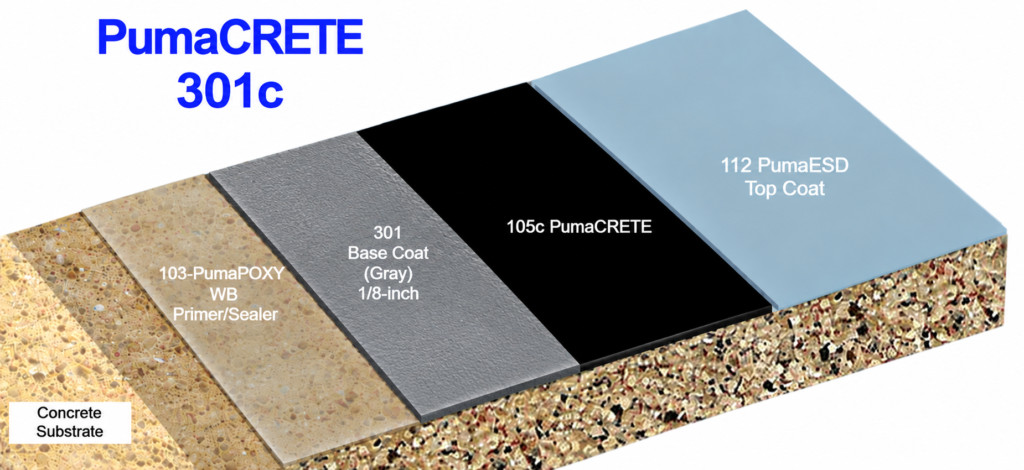
PumaCRETE 301-PumaESD-c
THICKNESS: 1/8 inch (enhance durability for impact and frequent motorized lift traffic, or restoration of damaged concrete surfaces)
Heavy-duty 1/4″ conductive urethane cement topping. Rocket motor casting, LAP lines, artillery production, DoD magazines, mine stores.
RESURFACER ADVANTAGES
Enhanced durability for impact and frequent motorized lift traffic, or restoration of damaged concrete surfaces.
Custom resistance tuning:
For Class 0 initiator work and the most sensitivity-critical operations, PumaCRETE can tune systems as low as 400,000 ohms with charge-generation under 20 volts. Contact our engineering team for a facility-specific recommendation.
Small-Arms Operations We Serve
PumaCRETE serves the full small-arms production chain, from primer manufacturing through finished-round packaging.
Primer Rooms & Primer Loading
Primer compound mixing, pelletizing, anvil insertion, and primer-cup charging. The most sensitivity-critical area in any small-arms plant.
Cartridge Case Preparation
Case cleaning, annealing, resizing, and inspection. Conductive flooring runs through case prep even though the energetic material is not yet present.
Powder Charging & Bullet Seating
Powder filling, charge verification, bullet seating, and crimping. Smokeless powder is less sensitive than primer compound but still requires conductive flooring.
Finished-Round Packaging
Carton loading, pallet staging, and shipping prep. Heavy pallet-jack and forklift traffic — 301 Series territory.
Why Primer Rooms Set the Floor Spec
The primer is the most sensitive component in a small-arms cartridge, and the primer room is the most sensitivity-critical space in the plant. Many small-arms producers specify the primer-room floor first and let that spec drive the rest of the facility.
Primer Rooms
Tuned toward 400,000 ohms. 200 Series coating. Non-sparking aggregates mandatory. Highest sensitivity-handling spec in the facility.
Loading & Packaging
25,000 ohms to 106 ohms. 200 or 301 Series depending on traffic. Same non-sparking requirement; different durability class.
Installation, Grounding & Field Testing
Small-arms installations have two application-specific considerations beyond the standard PumaCRETE install process.
Primer-Room Isolation
Primer rooms are typically physically isolated from the rest of the plant. The floor design maintains electrical continuity between the primer-room grounding grid and the plant-wide ground, so personnel-flow between zones does not introduce a charge-handoff problem.
Operational-Plant Retrofits
Commercial small-arms producers run continuous shifts year-round and cannot absorb long shutdowns. The 401-ECO low-odor, fast-cure system allows sectional installation one bay at a time, with the plant continuing to operate adjacent areas. Standard retrofit sequence: primer rooms first (during a planned safety outage), loading lines next (sectionally), then packaging and staging.
Grounding Network
Conductive grounding strips embedded at columns or designated ground points every 1,500 square feet, with a tighter 1,000-sq-ft grid in primer rooms. Full ANSI/ESD STM7.1 verification testing on completion.
Frequently Asked Questions
Small Arms Ammunition FAQ's
Yes. PumaCRETE conductive systems meet the resistance range, non-sparking construction, and seamless-finish practices referenced in SAAMI safety guidelines for commercial small-arms ammunition manufacturing. We serve both SAAMI members and military contractors governed by DoD 4145.26-M.
The 200 Series conductive epoxy coating, tuned toward the lower end of the conductive range (around 400,000 ohms), is the standard primer-room specification. The tighter resistance envelope provides additional margin for primer compound sensitivity.
Yes. Commercial small-arms production is a core PumaCRETE customer segment. The 301 Series handles high-volume loading-line traffic for decades without resistance drift, and the 401-ECO system enables sectional retrofits in operational plants.
Case preparation does not involve energetic material directly, but the conductive flooring runs continuously through the plant for operator-grounding consistency. The 200 Series coating is typical for case prep; traffic-heavy areas may step up to the 301 Series.
Yes. PumaCRETE conductive systems are chemically resistant to smokeless powder, nitrocellulose-based propellants, cleaning solvents, and the cutting oils used in case prep. Routine powder spills do not degrade the floor resistance or finish.
Yes. Commercial small-arms producers routinely retrofit with the 401-ECO fast-cure system, phasing installation one bay at a time. Standard sequence is primer rooms first (during a planned safety outage), then loading lines, then packaging areas.
Not isolated — connected. The primer-room grounding grid ties into the plant-wide earth ground, so personnel moving between zones do not carry a charge-handoff between areas with different ground references. The tighter 1,000-sq-ft grid in primer rooms provides more frequent ground paths within the sensitive area.
At least annually, and after any floor repair, line reconfiguration, or significant change in primer chemistry. Commercial producers often tie recertification to their SAAMI safety audit cycle.
EXPERIENCE AND EXPERTISE
Specify PumaCRETE for Your Small-Arms Facility
Primer room, cartridge loading line, powder-charging bay, or an operational-plant retrofit — PumaCRETE engineers the floor to the primer-sensitivity, traffic, and SAAMI or DoD requirements your production actually demands.
