Explosives Storage & Depots Flooring
Conductive urethane cement and epoxy flooring systems for military explosives magazines, Ammunition Supply Points (ASPs), military depots, ATF-licensed commercial storage facilities, and bulk explosive magazines. Heavy-duty traffic ratings with full DoD 6055.09-M and NFPA 495 compliance.
GET A FREE QUOTE

Flooring Built for the Full Spectrum of Explosives Storage
The storage end of the explosives business — from a DoD Depot Ammunition Supply Point receiving pallets of finished rounds, to an ATF-licensed commercial magazine holding bulk emulsion for a blasting contractor — demands flooring that handles sustained traffic without compromising the conductive-ground path that keeps the stored material safe.
PumaCRETE® builds magazine and depot floors around the specific storage mission. The 301 Series conductive urethane cement is standard for high-traffic depot and ASP work. The 200 Series coating fits smaller commercial magazines and ATF-licensed Type 2 and Type 4 structures. Both meet the 25,000-ohm to 1-megohm resistance envelope mandated by DoD 6055.09-M, NFPA 495, and ATF 27 CFR Part 555.
This page sits in the PumaCRETE DoD, Explosives pillar. For related operations, see Munitions & AA&E, Commercial Blasting & Mining, and Demilitarization & EOD.
Standards & Compliance Framework
Magazine and depot flooring answers to DoD, NFPA, OSHA, and ATF regulations — the exact mix depends on whether the facility is government or commercial.
DoD 6055.09-M
DoD Ammunition and Explosives Safety Standards. Primary regulation for DoD-owned magazines, depots, and ASPs.
DoD 4145.26-M
Contractors’ Safety Manual. Flooring requirements for contractor-operated storage facilities.
ATF 27 CFR Part 555
Commerce in Explosives. Federal magazine licensing (Types 1–5) with construction requirements referencing NFPA 495.
OSHA 29 CFR 1910.109
Explosives and Blasting Agents. Worker-safety baseline for magazine storage and handling.
DOT 49 CFR 173
Shippers — General Requirements for Shipments and Packagings. Applicable to depot shipping and receiving operations.
Technical Requirements Magazine & Depot Flooring
Storage facilities emphasize heavy-duty traffic performance (pallet jacks, forklifts, drum handlers) alongside the conductive-resistance requirements of DoD and NFPA.
| Property | Requirement | Reference |
|---|---|---|
| Resistance to Ground | 25,000 ohms – 1.0 × 10⁶ ohms | DoD 6055.09-M, NFPA 495 |
| Point-to-Point Resistance | < 1.0 × 10⁶ ohms | ANSI/ESD STM7.1 |
| Spark Behavior | Non-sparking; no exposed ferrous aggregates | NFPA 495 |
| Impact Resistance | Pallet drops, drum rolls, dropped-tool impacts | ASTM D2794 |
| Abrasion Resistance | Forklift tires, pallet-jack wheels, continuous cart traffic | ASTM D4060 |
| Compressive Strength | > 10,000 psi (301 Series urethane cement) | ASTM C579 |
| Seamless Construction | Monolithic — no joints trapping fines or moisture | Facility best practice |
| Chemical Resistance | Fuel oil, lubricants, cleaning agents, residual propellant | Facility-specific |
Why urethane cement for depots:
The 301 Series urethane cement topping is the standard specification for high-traffic depot and ASP floors because it combines the conductive-resistance requirement with the compressive strength and impact resistance of a 1/4-inch screed-applied topping. A thin-film coating cannot sustain the duty-cycle of a loaded forklift moving pallets of finished rounds 10 hours a day.
The PumaCRETE® System Families
Two product families cover the full DoD and explosives pillar. Each sub-industry page specifies the system most often used for that application; the three families below are the common foundation.

PumaCRETE 200-PumaESD-c
THICKNESS: 13-45 mils enhanced durability for impact and frequent motorized lift traffic, or restoration of damaged concrete surfaces)
Mid-build conductive epoxy coating. Primer rooms, igniter assembly, pyrotechnic mixing, lighter-duty cartridge production.
Target Resistance
25,000 ohms – 1.0 × 10⁶ ohms
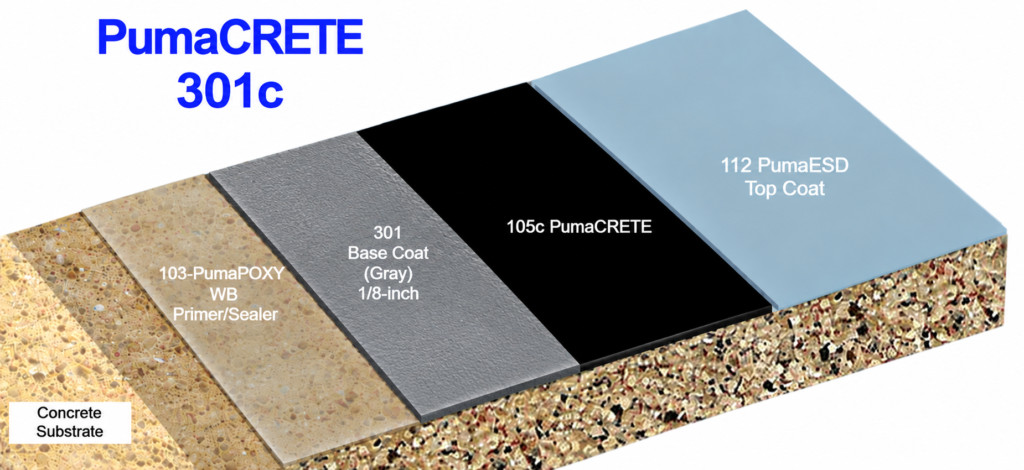
PumaCRETE 301-PumaESD-c
THICKNESS: 1/8 inch (enhance durability for impact and frequent motorized lift traffic, or restoration of damaged concrete surfaces)
Heavy-duty 1/4″ conductive urethane cement topping. Rocket motor casting, LAP lines, artillery production, DoD magazines, mine stores.
RESURFACER ADVANTAGES
Enhanced durability for impact and frequent motorized lift traffic, or restoration of damaged concrete surfaces.
Custom resistance tuning:
For Class 0 initiator work and the most sensitivity-critical operations, PumaCRETE can tune systems as low as 400,000 ohms with charge-generation under 20 volts. Contact our engineering team for a facility-specific recommendation.
Storage Sub-Industries We Serve
The storage branch spans military, federal, and commercial operators. Each sub-industry has its own dedicated page.
DoD Magazines & ASPs
DoD depots, Ammunition Supply Points, arsenals, and military magazines. The highest-traffic end of the storage spectrum.
ATF-Licensed Facilities
Federally licensed Type 1, 2, 3, 4, and 5 magazines for commercial manufacturers, importers, dealers, and users of explosives.
Commercial Explosives Storage
Private-sector bulk explosives storage for blasting contractors, mining operators, and demolition firms.
Related — Mining Magazine Flooring
On-site mining magazines fall under MSHA jurisdiction and are covered under the Commercial Blasting & Mining branch.
Why Magazine Floors Carry a Higher Burden
Magazine and depot floors have a dual job that other explosives floors do not. First, the resistance-and-spark-safety requirement that any explosives floor carries. Second, the sustained heavy-equipment traffic that comes with moving pallets of finished rounds and bulk explosives for the full life of the facility.
Production Floors
Mostly workstation and cart traffic. A 200 Series coating is often sufficient.
Magazine & Depot Floors
Daily forklift and heavy pallet traffic for decades. The 301 Series urethane cement is the only system that holds up without compromising conductivity.
Installation, Grounding & Field Testing
Magazine installations are built around the facility’s active mission — most depots cannot shut down a full magazine building for a multi-week install.
1
Sectional Installation
For large depots and ASPs, PumaCRETE phases the install one bay at a time, using the 401-ECO fast-cure system where return-to-service is critical. Stored munitions are shifted sectionally; the floor crew installs behind them.
2
Grounding Network
Conductive grounding strips are embedded at columns or designated ground points every 1,500 square feet, bonded to the building's earth ground. For multi-bay magazines, the ground network is designed with the facility electrical engineer to tie into existing lightning protection.
3
Documentation
Full ANSI/ESD STM7.1 test reports are provided for the facility safety file and DoD, ATF, OSHA, or MSHA audit record. Depot projects include a facility-wide resistance map tied to as-built drawings.
Frequently Asked Questions
Explosives Storage & Depots Flooring FAQ's
ASP stands for Ammunition Supply Point — a military installation that receives, stores, and issues ammunition and explosives for operational units. ASPs are typically operated under DoD 6055.09-M and are among the highest-traffic magazine environments in the industry.
ATF 27 CFR Part 555 defines five magazine types by construction and intended use. Type 1 and 2 are indoor and outdoor permanent magazines for high explosives. Type 3 is a day-box for temporary attended storage. Type 4 is for low explosives and blasting agents. Type 5 is for ammonium nitrate and certain blasting agents in bulk. Each type has specific flooring requirements referenced through NFPA 495.
Yes. All PumaCRETE conductive systems meet the resistance-to-ground range (25,000 ohms to 1.0 × 10⁶ ohms), non-sparking construction, and seamless-finish requirements specified under DoD 6055.09-M for government-owned magazines, depots, and ASPs.
Depot and ASP floors see sustained forklift, pallet-jack, and drum-handling traffic for the full life of the facility — often 50+ years. A thin-film coating cannot sustain that duty cycle. The 1/4-inch 301 Series urethane cement topping provides the compressive strength and impact resistance to handle depot traffic while maintaining the conductive-resistance envelope.
Yes. PumaCRETE's 401-ECO low-odor, fast-cure system allows sectional installation with 12-hour return-to-service. Multi-bay depots are typically phased one bay at a time, with stored munitions shifted ahead of the install crew.
Not directly, but the two systems are coordinated. The floor grounding ties into the building's earth ground network, which also serves the lightning protection system. For high-exposure magazines, we recommend reviewing the full ground network design with the facility electrical engineer during the project specification phase.
At least annually, and after any floor repair, structural modification, or significant change in operations. PumaCRETE testing crews can return for scheduled recertification tied to the facility's annual safety inspection cycle.
Yes. Commercial blasting operators licensed by ATF are a core customer segment. The Commercial Blasting & Mining branch of this pillar covers the specific requirements for blasting-contractor magazines.
EXPERIENCE AND EXPERTISE
Specify PumaCRETE for Your Magazine or Depot Project
DoD depot, Ammunition Supply Point, ATF-licensed commercial magazine, or a bulk explosives storage facility — PumaCRETE engineers the floor to the resistance, traffic, and documentation requirements your facility actually needs.
