Food & Beverage · Floor Compliance
USDA, FDA & SQF Compliant Floors for Food Plants
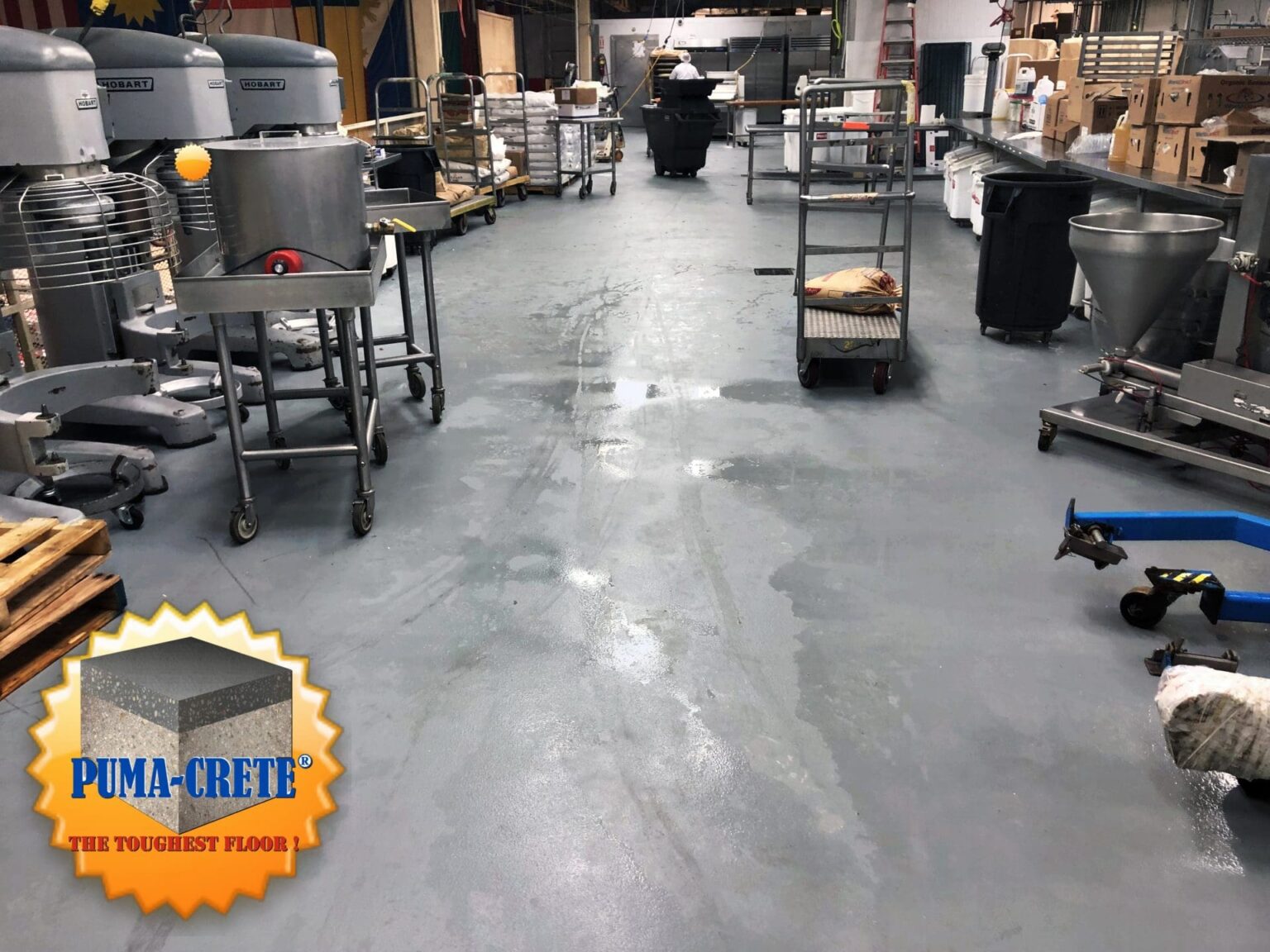
Looking for USDA-approved flooring? Neither USDA nor FDA approves flooring products. Inspectors and auditors judge the floor in front of them: impervious to moisture, cleanable, in good repair, sloped to drain and coved at the walls. PumaCRETE urethane concrete is built to pass that inspection and keep passing it for 20+ years.
9 CFR 416
USDA-FSIS sanitation standards
21 CFR 117
FDA food plant CGMPs
SQF 11.1.2.1
Edition 10 floor clause
5-yr
Written Warranty
GET A QUOTE

What "USDA-approved flooring" really means
“USDA-approved flooring” is a common search, but it describes a standard, not a product list. FSIS regulations set what a floor must do; they do not name materials or brands. FSIS also states that letters of guaranty are not required for construction and repair materials used on surfaces that do not touch food, such as floors.
FDA works the same way. Food plants must keep floors cleanable and in good repair under 21 CFR 117.20, and retail and foodservice kitchens follow the FDA Food Code. Third-party schemes such as SQF and BRCGS add their own floor clauses. What passes is a floor that meets every one of them on the day of the inspection.
What inspectors and auditors check
- Cracks, pitting or spalled concrete that hold water and soil
- Ponding water that does not reach a drain
- Peeling or delaminating coatings, especially near ovens, kettles and washers
- Open or broken floor-to-wall junctures and failed cove
- Damaged floor around drains, equipment legs and doorways
- Floors on the master sanitation schedule, with repairs logged in maintenance records
Floor requirements, rule by rule
The rules that apply to most U.S. food and beverage plants, what each asks of the floor, and how a PumaCRETE floor answers it. Rule text is summarized; follow the links for the full wording.
| Authority | Rule | What it requires of floors | How PumaCRETE meets it |
|---|---|---|---|
| USDA-FSIS | 9 CFR 416.2(b)(2) | Floors built of durable materials impervious to moisture, cleaned and sanitized as needed. | Seamless, non-porous urethane concrete; 9,500 psi; daily sanitizer and hot-washdown resistant. |
| USDA-FSIS | 9 CFR 416.2(e)(4) | Adequate floor drainage wherever floors get flooding-type cleaning or process water. | Slope-to-drain correction built into the install, so water reaches the drain instead of ponding. |
| FDA (food plants) | 21 CFR 117.20(b)(4) | Plant built so floors can be adequately cleaned, kept clean and kept in good repair. | Smooth, jointless surface with integral cove; 20+ year service life; repairs possible in operating coolers at 35°F. |
| FDA Food Code (retail & foodservice) | 6-201.11, 6-201.13 | Floors smooth and easily cleanable (anti-slip finishes allowed); where floors are water-flushed, drains, grading to drain, and coved, sealed floor-wall junctures. | Texture set per room (0.6–0.9 wet COF), 4–6 in integral cove, slope-to-drain. |
| SQF Edition 10 | Food Manufacturing 11.1.2.1 | Smooth, dense, impact-resistant floors that can be graded and drained, are impervious to liquid and easy to clean, sloped to drains. | >160 in-lb impact resistance; seamless and impervious; graded to drain during install. |
| BRCGS Food Safety Issue 9 | Clause 4.4.3 | Floors hard-wearing enough for the process, able to withstand cleaning, impervious, in good repair and easy to clean. | Rated -40°F to 248°F with thermal-shock resistance; built for CIP chemistry and daily washdown. |
How PumaCRETE meets every requirement
Impervious to moisture
One continuous, non-porous surface with no grout lines or joints for water and bacteria to get into. Bonds to damp concrete and tolerates up to 25 lbs of vapor pressure through the slab.
Durable and hard-wearing
9,500 psi compressive strength and more than 160 in-lb impact resistance for forklifts, pallet jacks and steel carts.
Cleanable and sanitizable
Built for daily contact with caustic and acid CIP chemistry, quats, chlorine, peracetic acid and hot washdowns, across a -40°F to 248°F service range.
Graded to drain
Slope corrections are part of the install, so floors flushed with water drain fully and do not pond.
Coved and sealed at the walls
A 4–6 in integral cove base trowelled in the same material closes the floor-to-wall juncture.
Kept in good repair
20+ year service life, a 5-year written warranty, and repairs that cure down to 35°F so cold rooms stay in production.
Documentation for your food safety file
- Technical data sheets with ASTM test results for the installed system
- QA close-out package for your food safety file and your auditors
- 5-year written warranty on material and workmanship
- Chemical resistance confirmed against your own sanitation chemical list
- Room-by-room specification: thickness, texture, cove and slope
Performance data
| Property | PumaCRETE 401-HF |
|---|---|
| Compressive strength | 9,500 psi (ASTM C579) |
| Tensile strength | 1,450 psi (ASTM C307) |
| Flexural strength | 3,200 psi (ASTM C580) |
| Bond to concrete | Exceeds substrate (ASTM D7234) |
| Abrasion resistance | 0.06 g loss (ASTM C501) |
| Impact resistance | >160 in-lb (ASTM D2794) |
| Service temperature | -40°F to 248°F |
| Thermal shock | Pass, boiling-to-ambient cycles |
| Wet coefficient of friction | 0.6–0.9 (tunable) |
| Vapor pressure tolerance | Up to 25 lbs through the slab |
| Minimum install temperature | 35°F (operating coolers) |
| Standard thickness | 1/4 in (3/8 in in thermal zones) |
Standard 1/4-inch PumaCRETE 401-HF system. Full test data is on the technical data sheets.
Sector-specific rules
Some sectors carry rules of their own on top of the general ones. Each sector page covers them room by room.
| Sector | Additional rules | Sector page |
|---|---|---|
| Meat & poultry plants | USDA-FSIS 9 CFR 416; 9 CFR 430 for ready-to-eat products | Meat & Poultry |
| Dairy plants | Grade “A” Pasteurized Milk Ordinance | Dairy & Cheese |
| Egg products | 9 CFR 590 | Egg Processing |
| Seafood | Seafood HACCP, 21 CFR 123 | Seafood |
| Juice | Juice HACCP, 21 CFR 120 | Fruit, Vegetable & Juice |
| Acidified foods | 21 CFR 114 | Sauces, Pickling & Fermented Foods |
| Pet food and rendering | FSMA animal food rule, 21 CFR 507 | Pet Food & Animal Feed |
| Commercial kitchens | FDA Food Code as adopted by your state | Prepared Foods & Commercial Kitchens |
Three ways to buy, direct from the manufacturer
Every system on this page is made by PumaCRETE and sold direct, with no distributor markup.
Buy the materials
Urethane concrete, primers, topcoats and cove kits shipped direct from the manufacturer to your plant. No distributor markup.
Buy it installed
Turnkey installation by factory-trained crews, with material and workmanship warranties from a single source.
Train your own crew
A factory-employed PumaCRETE trainer certifies your maintenance team or local contractor on your slab: prep, mixing, troweling, cove and testing.
Frequently Asked Questions
USDA, FDA & SQF flooring FAQ
USDA does not approve, certify or list flooring products, so no floor is USDA approved in a formal sense. FSIS inspectors judge whether the installed floor meets 9 CFR 416: durable, impervious to moisture, cleanable and adequately drained. PumaCRETE urethane concrete is built to meet those standards in USDA-inspected meat and poultry plants.
No. FDA-regulated food plants must be built so floors can be adequately cleaned, kept clean and kept in good repair (21 CFR 117.20). Retail and foodservice kitchens follow the FDA Food Code as adopted by their state, which calls for smooth, easily cleanable floors and coved floor-wall junctures.
FSIS states that letters of guaranty are not required for construction and repair materials used on surfaces that do not contact food, such as floors, walls and ceilings. We provide technical data sheets and a QA close-out package for your records.
In the SQF Food Manufacturing Code, Edition 10, clause 11.1.2.1 calls for floors made of smooth, dense, impact-resistant material that can be graded and drained, is impervious to liquid and is easy to clean, sloped to drains so wastewater is removed under normal working conditions.
It can be, if it stays impervious, cleanable and in good repair. In wet processing rooms, bare and sealed concrete tends to crack, pit and absorb moisture under hot washdowns and sanitizers, which is a common audit finding. Urethane concrete was developed for exactly those rooms.
Often, yes. PumaCRETE installs and cures down to 35°F, and installs are planned around your production calendar, room by room. Foot traffic returns in 6 hours and forklifts and CIP service in 24 hours at 70°F.
A floor in good repair with no cracks, ponding or failed cove, floors on the master sanitation schedule, and maintenance records for repairs. We provide the data sheets, warranty and close-out documentation to put in your food safety file.
EXPERIENCE AND EXPERTISE
Ready for a floor that passes every audit?
Get a no-obligation site assessment. We review your rooms, chemistry, temperatures and production calendar, then deliver a written specification and budget within five business days.
